After an affair · Individual and couples support
Infidelity therapy for expats
Discovering an affair can leave you questioning the relationship and the life you have built abroad. You can seek support before you know whether you want to stay together. I offer online therapy for individuals and couples, with room for difficult questions and decisions that remain yours.
Book a free consultation
When an affair unsettles your life abroad
Your partner may also be your closest local connection, the reason you moved, or the person whose job supports your household. If the relationship feels uncertain, questions about housing, money, friendships and where to live can arrive at once.
You may want to tell someone at home and worry that doing so will make it harder to choose what happens next. Or you may be trying to work, parent and manage ordinary tasks while returning to the same unanswered questions.
Therapy offers a place to examine those questions. We can separate what needs attention now from what can wait. Practical deadlines still matter. Legal, immigration and financial decisions need advice from the relevant qualified professional.
You can come alone or enquire as a couple
My partner had an affair.
We can focus on the impact on you, what information you need, your boundaries and the support available outside the relationship. You do not have to agree to forgiveness or reconciliation to begin.
I had the affair.
Individual work can help you examine your choices, take responsibility for the harm and decide what honest action requires now. Understanding your behaviour does not transfer responsibility to your partner.
We want to see whether repair is possible.
Couples work can explore the impact of the affair, what remains undisclosed or unresolved, and whether both people are willing to participate in change. Therapy cannot promise that trust or the relationship will recover.
We want different things.
One of you may want to continue while the other is uncertain or wants to leave. We can name that difference and consider whether joint work has a useful, freely agreed purpose.
If you attend alone, we work with your experience. I cannot assess your absent partner or tell you what they really think.
What we might work on first
We begin with what is happening now. Has contact with the other person ended? What has been disclosed? What conversations keep escalating or going nowhere? Are both of you able to say what you want without intimidation?
For the partner who has been betrayed, questions may concern what happened, whether the account keeps changing and what would make daily life manageable. For the partner who had the affair, work may include answering for their choices without using shame, defensiveness or the relationship’s earlier difficulties to evade responsibility.
We can later examine the wider relationship if that serves the work. Problems between you do not make the betrayed partner responsible for the affair. Equally, an apology does not oblige them to stay.
If the affair is ongoing or important information is being concealed, that changes what joint work can realistically do. Before starting, we agree how confidentiality and information shared individually will be handled.
Making decisions without being pushed towards an ending
Some people want to attempt repair. Some want support with separation. Others need time to understand what they are willing to live with. My role is to help you examine your experience and choices, not to campaign for one outcome.
A useful starting point may be a boundary for the coming week: which conversations you can manage, where you will get support, or what practical information you need before a decision. If ending the relationship is becoming the main question, see separation therapy for expats.
Where there is fear, coercion or violence, joint therapy may not be appropriate. Tell me privately about safety concerns when enquiring. The NHS guide to domestic abuse support explains options, including support for men. If you are abroad and in immediate danger, use local emergency services.
How we begin
I am Kita Tabachka, a Bulgarian-born, UK-based BACP-registered relational therapist. My work includes individuals and couples living abroad. You can read about my approach and check my BACP directory profile.
We start with a free 15–20 minute consultation. You can tell me what brings you, ask questions and decide whether you would like to continue. We discuss your needs, the country you will attend from, privacy and available appointments before agreeing to work together.
For couples work, both partners attend the consultation. If we begin, I usually meet each of you individually to understand your background before joint sessions. We agree the purpose, fees and confidentiality arrangements for those meetings first.
Individual therapy: £70 for 50 minutes.
Couples therapy: £100 for 70 minutes, per couple.
Sessions are online through Carepatron. Read the fees and process.
Online therapy while living abroad
I work online from the UK. I do not have a clinic in your city. Before accepting an appointment, I check your location, professional arrangements and whether this service fits your needs. Tell me before travelling or moving country so we can review whether the work can continue. Read how therapy across borders is assessed.
You need a private place to speak, a suitable device and a reliable connection. We agree confidentiality and its limits before starting. Appointment availability is confirmed in your local time.
If you and your partner attend from different countries, we check both locations. If you are looking for support with betrayal without the relocation context, read about therapy for broken trust.
Questions you may have
Do we have to agree to stay together before couples therapy?
No. You can enquire while uncertain. We need to establish an appropriate purpose for the work that both partners freely agree to. Therapy does not require or guarantee reconciliation.
Can I have therapy if my partner refuses?
Yes. Individual therapy can focus on your experience, boundaries and decisions. It cannot make your partner participate or change.
Will you tell me whether the affair means we should separate?
No. We can explore what happened, its impact and your options. The decision remains yours, including whether you want time to consider it.
Can we join from different countries?
It may be possible. We need to check both locations, professional arrangements, privacy and suitability before accepting appointments.
What does infidelity therapy cost?
Individual sessions cost £70 for 50 minutes. Couples sessions cost £100 for 70 minutes per couple. Both partners attend the free 15–20 minute couples consultation. Any separate background meetings and their fees are agreed before starting.
Where to go next
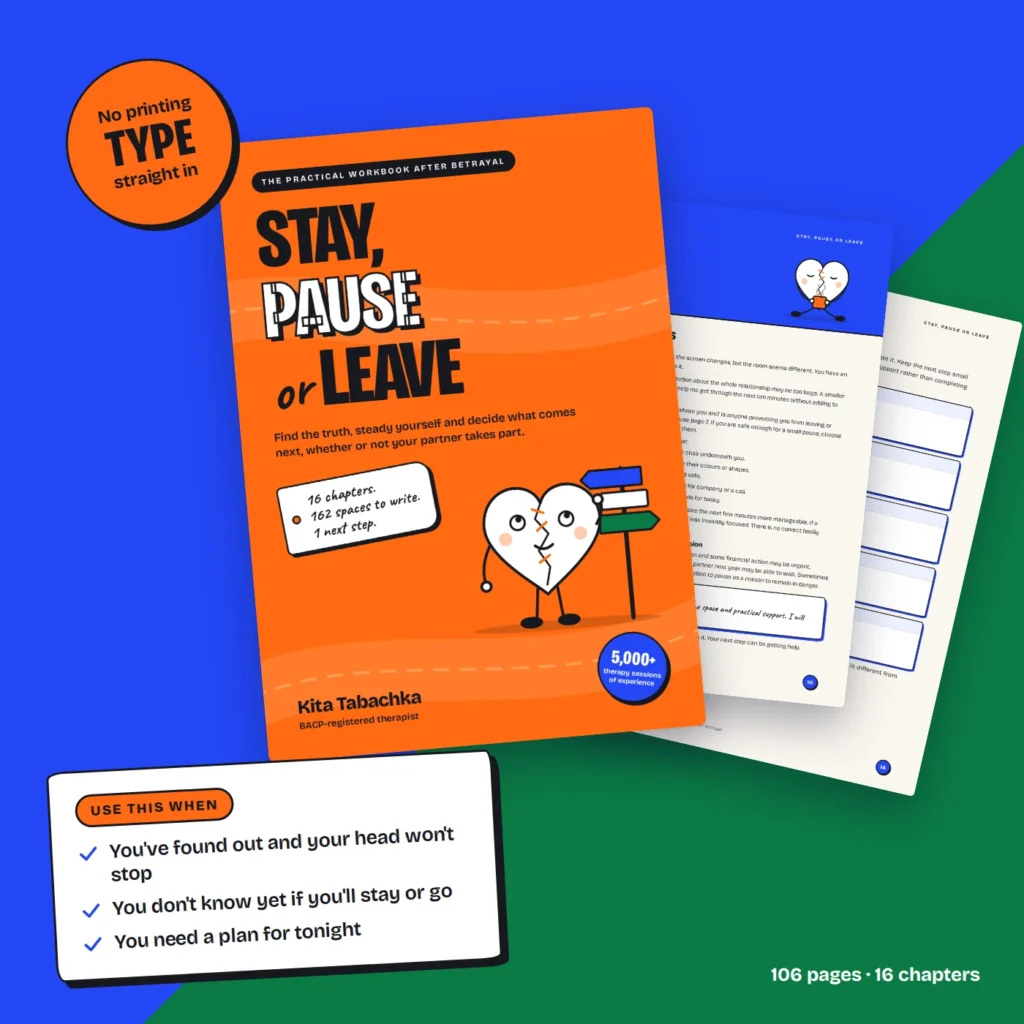
Stay, Pause or Leave
You found out. Now everyone has an opinion and you have a decision. This workbook takes you through the weeks after betrayal in order: steady yourself first, get the facts straight, then decide. Written from my practice.
£29, instant PDF download
Get the workbookA companion to therapy, not a substitute for it.