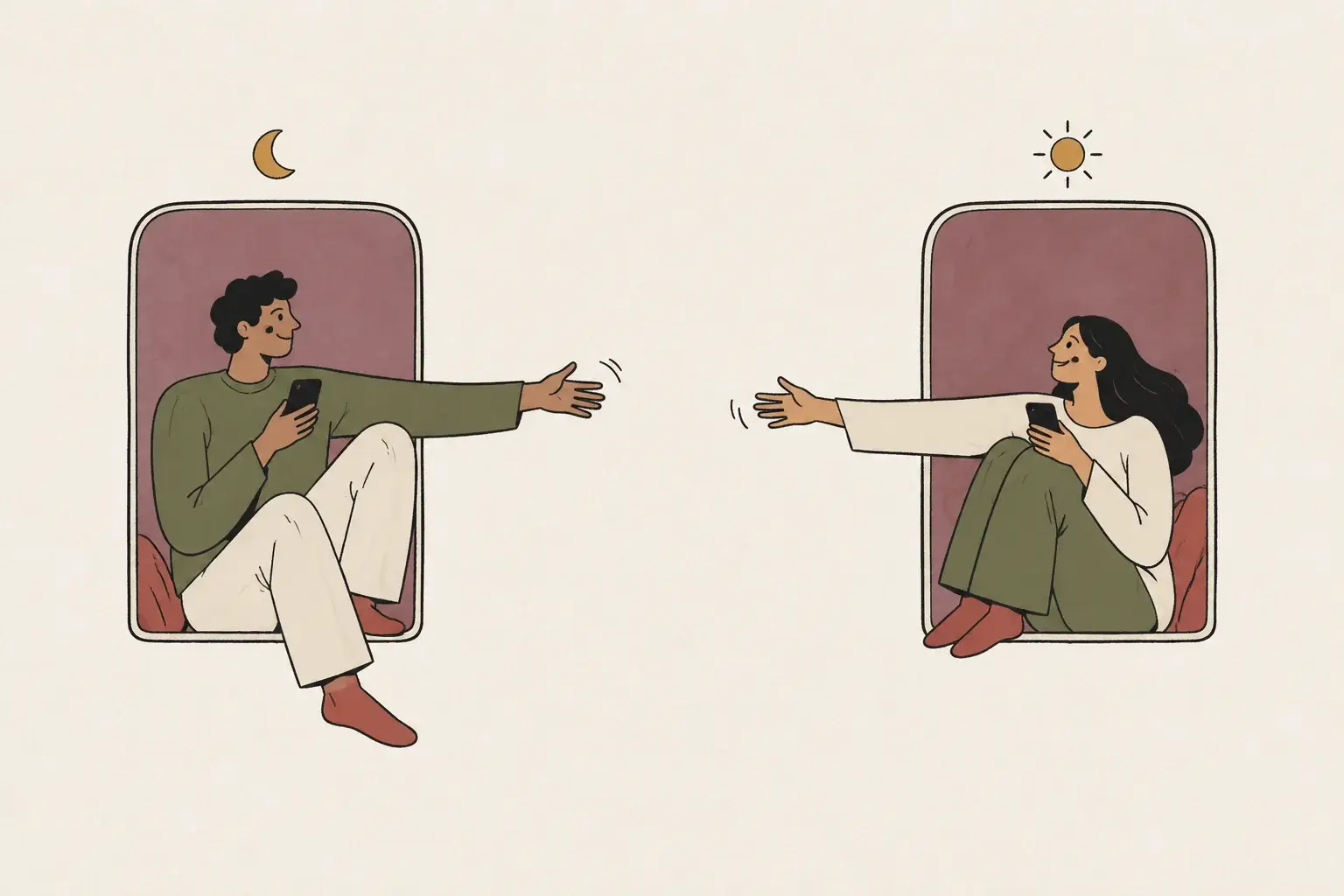
How do we make different time zones work?
One person is ready to talk just as the other is leaving for work. Good news has to wait. A difficult conversation starts when one of you can barely stay awake. These are practical obstacles, but they can also leave you feeling that your relationship gets whatever time is left over.
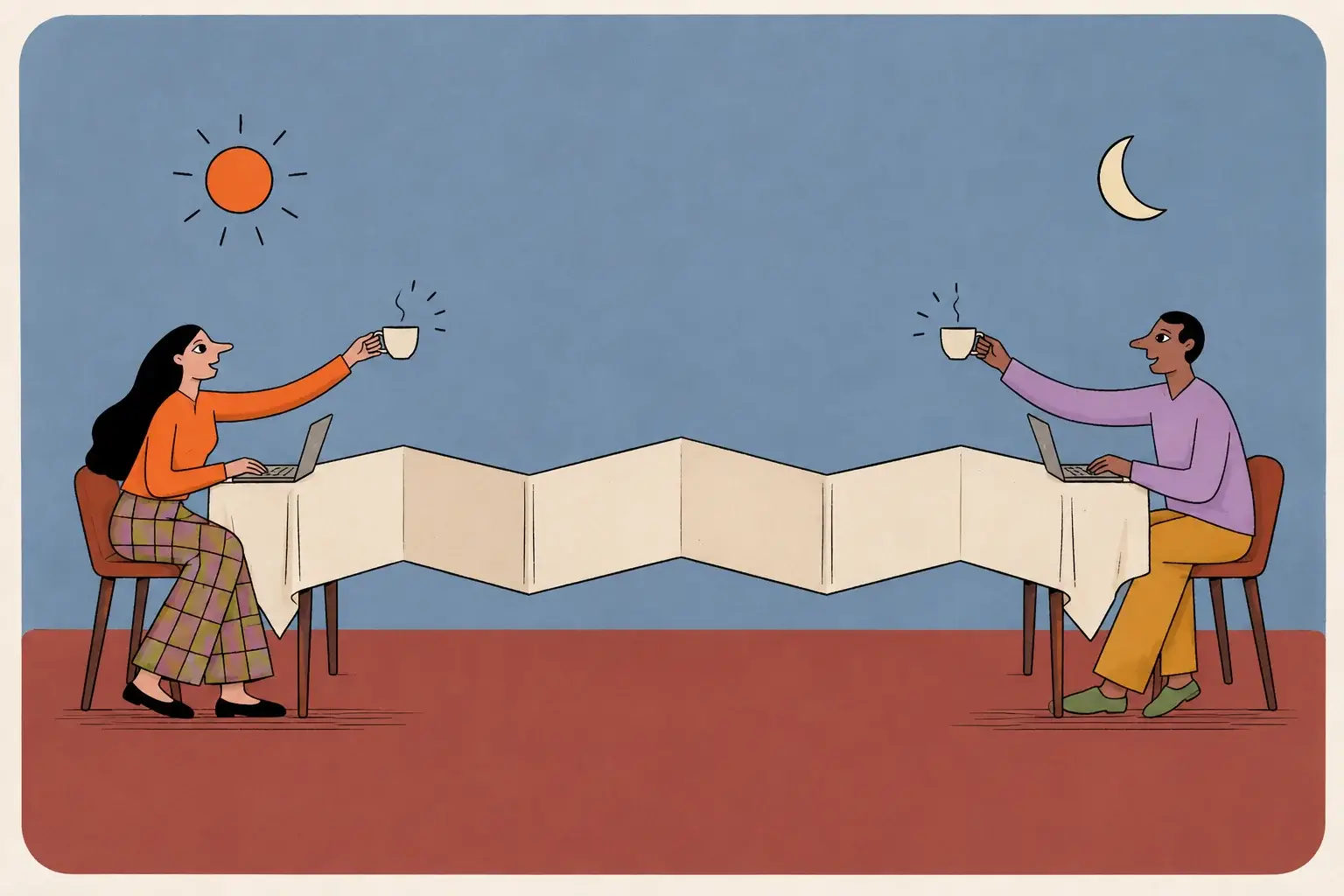
Begin with your actual week. Include sleep, shifts, commuting, childcare and time you want to spend with other people. Check each other’s local time, including changes for daylight saving. A schedule that depends on one person being exhausted is unlikely to feel fair.
Five questions for your contact agreement
- When can we give each other our attention? Choose realistic windows, and distinguish a brief hello from time for a longer conversation.
- When should we expect no reply? Name work, sleep and other commitments. Being offline needs to be possible without either of you having to defend it.
- What happens if a plan changes? Agree how to send an update and suggest another time. Decide what to do if an update is not possible.
- Who takes the inconvenient slot? Look at the pattern over a week or month. Fairness may mean rotating late calls, or finding a different arrangement altogether.
- When will we review this? Pick a time to discuss what worked and what was unrealistic. Changing an agreement is different from quietly abandoning it.
An example you can adapt
“I want our calls to be something we look forward to. Could we choose two times this week when we are both properly available? If one changes, let’s suggest another. I also need us to look at the late nights, because I am struggling at work the next day.”
This is a conversation prompt, not a prescription for two calls a week. Your preferred amount of contact may be different.
What if a missed call turns into an argument?
Separate the practical problem from the interpretation. “We agreed to talk and I waited for an hour” gives you something specific to discuss. “You never care about me” asks your partner to defend the whole relationship before you can address the missed call.
The person who missed it can explain what happened and acknowledge the impact. Then decide what should happen differently next time. An apology without a workable change may leave you having the same conversation a week later.
If either of you needs to pause an argument, agree when you will return to it, in both local times. A pause should not leave someone waiting indefinitely. If repeated messages have become a way of demanding an immediate response, discuss that boundary too.
A delayed reply alone does not prove a lack of love or a betrayal. Repeated broken agreements still matter. Look at what is happening over time, rather than asking a single message to answer the whole question.
How can we feel close between calls?
Share parts of ordinary life as well as relationship updates. A voice note about your walk, a photo of something funny, or a recommendation can invite connection without requiring an immediate reply. Ask what the other person actually enjoys receiving.
Some couples enjoy cooking at the same time or watching something together. Others prefer a shorter conversation with fewer distractions. Neither arrangement proves that you care more. Try something you both want, then notice whether it leaves you feeling connected or adds another obligation.
Intimacy also needs choice. Being far apart does not create an obligation to share sexual images or be available for intimate calls. Read more about emotional and sexual intimacy across time zones.
The conversation a better schedule cannot replace
A contact plan will not resolve uncertainty about whether you will ever live in the same place. You may need to discuss who could move, what each person would give up, and what would make the arrangement worth continuing.
You do not need every answer immediately. You do need room to say when the current arrangement is no longer working for you. If moving would put one career on hold, the guide to resentment after moving for a partner can help you name costs before they become unspoken expectations.
When another contact plan is not enough
Consider support when every discussion about contact becomes an argument about commitment, when one person’s needs consistently disappear, or when trust has been damaged and practical agreements are no longer enough.
In long-distance relationship counselling, you can join an online appointment from different locations, where both locations are suitable for the work. We can use a recent missed call or disagreement to understand how the conversation breaks down and practise a different response.
Couples sessions cost £100 for 70 minutes, per couple. We begin with a free joint consultation, followed by individual background meetings before joint work. The arrangements and fees for those meetings are explained first.
If you want individual support in writing, weekly written counselling costs £50 for one personal reply through Carepatron. It is an individual exchange rather than a joint couples appointment.
Questions you may have
How often should long-distance couples talk?
There is no single frequency that fits every couple. Agree what each of you wants and can realistically offer, including sleep, work and other responsibilities. Review whether the arrangement works for both of you.
How do we manage a large time-zone difference?
Identify your available hours in both local times, share the inconvenient slots where possible, and agree what to do when a call changes. Check daylight-saving changes rather than assuming the offset stays the same.
What if one person needs more contact?
Discuss what that contact provides: reassurance, shared daily life, practical planning or time for intimacy. Then consider which needs you can meet together and which expectations are unrealistic. Constant availability should not become a test of commitment.
Can we attend therapy from different countries?
Potentially. Tell me where each of you will be attending from so I can confirm suitability and professional arrangements before we begin. Each person needs a private space and a reliable connection.
Can a relationship survive years of long distance?
Some do. Duration alone cannot tell you whether the arrangement suits you. Discuss whether it remains a shared choice, the costs for each person and how you will make decisions about the future.
Sources and further reading
The contact questions and examples above are practical prompts, not a validated assessment or a guarantee that a relationship will continue. The BACP guide to getting therapy explains what to consider when choosing professional support.