
Leo found the messages on a Sunday, on the family iPad, because the accounts were linked. By Tuesday he had a spreadsheet: dates, hotels, the name. By Friday he had asked me one question, in the first four minutes of our first session. “Do people come back from this?”
Many do. Some couples who come through an affair describe the marriage afterwards as more honest than the one before. Others separate, and some of them separate well. The affair itself rarely decides which. What decides it is what the two of you do in the months after the discovery.
Yes, a relationship often survives infidelity. The couples who make it share three things: contact with the affair partner ends completely and provably, the truth gets told once rather than in instalments, and the partner who strayed stays in the room for the anger instead of managing it. Where those three are missing, love alone rarely carries it.
01What decides it
People expect the answer to depend on the size of the affair. One night or two years. Sex or messages. In my room, the size matters less than the aftermath. A one-night affair followed by a year of lies about it does more damage than a long affair confessed, ended and faced.
The discovery is the injury. The months after decide whether it heals or turns septic. Every half-truth found later restarts the clock. Every time the partner who strayed says “can we move on now?”, the partner who was betrayed learns the pain is still not welcome.

02The three things
Leo’s wife, Ana, did all three. She ended it in front of him, answered the spreadsheet line by line, and did not once ask him to be over it. Eight months later Leo said the strangest thing about the whole year was how much they talked. They had not talked like it since the first flat in Lisbon.
The affair is the injury. The months after decide whether it heals.
Kita Tabachka, relational therapist
03What it asks of you
If you were betrayed, surviving it does not mean swallowing it. You are entitled to the facts, to your anger, and to time. You are not obliged to forgive on a schedule, and you do not have to decide in the first fortnight. Most people who make a decision they still stand by a year later make it somewhere between month two and month six.
If you strayed, surviving it means doing the hardest part without a reward in sight. You end it, you tell it straight, and you stay for the anger. Then comes the slower work of understanding why, which is often about people-pleasing, a life with no private room in it, or an exit you were too frightened to ask for. I wrote about those patterns in why people cheat.
Couples who come to me after an affair usually start with a few individual sessions for the partner who found out, then move to joint work. Many live abroad, where the affair lands with no family nearby and sometimes a visa tied to the marriage. Infidelity therapy for expats covers how the work runs.
If there is fear, control over money or documents, or any threat of harm, safety comes before repair. Speak to a specialist service in your country first. If you are in danger, contact local emergency services.
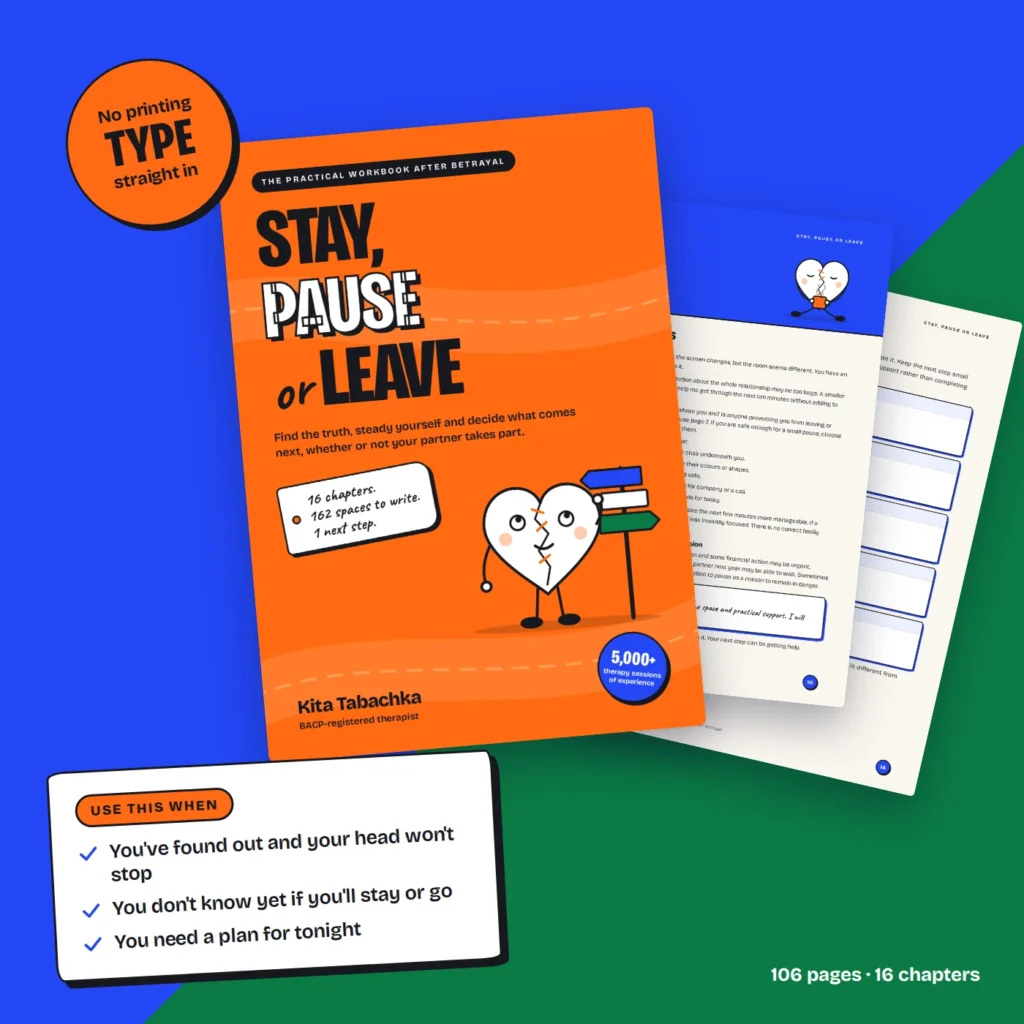
Survival shows in what your partner does over the next months. My workbook, Stay, Pause or Leave, gives you a route table and 42 scripts to judge repair by behaviour over time.
More from the journal

Weekly written counselling with Kita
When writing feels easier than speaking.
You can enquire about weekly written counselling for your own experience of relationships and life abroad. We agree whether this format is a useful fit before you pay.
Explore written counselling£50 per week. One personal written reply through Carepatron. Suitability, your weekly reply day and terms agreed before payment.

Kita Tabachka
I am a BACP-registered relational therapist. I work with individuals and couples, many of them living far from where they began, on relationship anxiety, attachment, intimacy and the strange business of building a self in a new country. The stories here are composites. The patterns are real. My writing is a door into the work, never a substitute for it.
More about my practiceQuestions people ask
This article is written by Kita Tabachka, MBACP, and is for general education and reflection. It describes patterns seen in clinical work, but it is not therapy, and it is not a substitute for individual advice from a qualified therapist, doctor or other professional who knows your situation.
Reading it cannot diagnose anything or replace your own judgement about what you need. If something here resonates and you would like support, you are welcome to learn more about my practice or book a free consultation. If you are in crisis or immediate danger, please contact local emergency services or an urgent mental health line in your country.
Join the conversation
If you have lived this, say so. Your words may be the thing a stranger at midnight needed to read.