
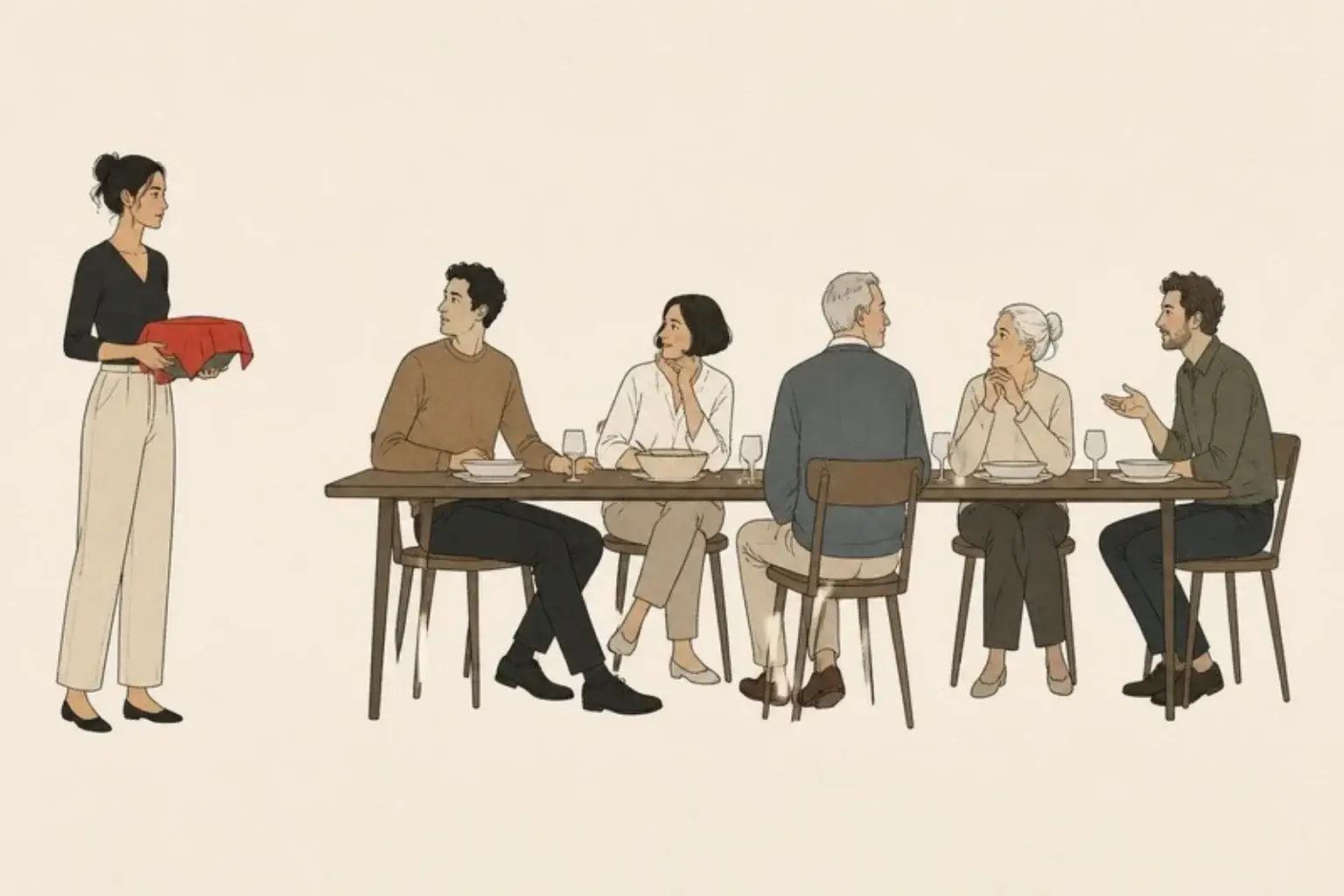
Every Eid for four years, Hannah has made the same lamb dish, from her mother-in-law’s recipe. Every Eid, it goes on the side table next to the shop-bought dates. Nobody says anything unkind. Nobody says anything at all. Her husband, Yusuf, eats two helpings when they get home. He has never once eaten it in front of his mother.
When your partner’s family does not accept you, the rejection hurts. Your partner’s silence about it usually hurts more. You cannot make the family accept you. You are free to ask your partner for visible support on specific things, and couples who stand together often find the family slowly adjusts to them.
01What rejection looks like
It is rarely a row. In cross-cultural and interfaith couples, it more often looks like a language you are left out of, photos you are not in, a recipe put on the wrong table, or a question about grandchildren asked only to your partner. Each moment is small enough to deny, and together they tell you where you stand.
02Why your partner freezes
What your partner says, and what is often underneath. Tap a card to turn it.
Many partners in this position grew up in close families where disagreement felt like betrayal. Therapists call the extreme version enmeshment. It is not a lack of love for you. It is a lack of practice at being separate from them. I wrote more about it in why people cheat, where it shows up for different reasons.
The family is the problem you see. Your partner’s silence is the one which hurts.
Kita Tabachka, relational therapist
03Asking for a stand
Do not ask your partner to choose you over his family. Ask for one visible act. “At Eid, I want you to put my dish on the main table yourself.” Small, specific, public. It tells the family the couple is a unit, and families adjust to units far faster than to individuals.
Yusuf put the lamb on the main table the next Eid. His mother said nothing. His aunt asked Hannah for the recipe. It took one act, after four years of hoping the family would change first. Cross-cultural couples therapy is for couples where family, faith, language and country are all in the room at once.
More from the journal

Weekly written counselling with Kita
When writing feels easier than speaking.
You can enquire about weekly written counselling for your own experience of relationships and life abroad. We agree whether this format is a useful fit before you pay.
Explore written counselling£50 per week. One personal written reply through Carepatron. Suitability, your weekly reply day and terms agreed before payment.

Kita Tabachka
I am a BACP-registered relational therapist. I work with individuals and couples, many of them living far from where they began, on relationship anxiety, attachment, intimacy and the strange business of building a self in a new country. The stories here are composites. The patterns are real. My writing is a door into the work, never a substitute for it.
More about my practiceQuestions people ask
This article is written by Kita Tabachka, MBACP, and is for general education and reflection. It describes patterns seen in clinical work, but it is not therapy, and it is not a substitute for individual advice from a qualified therapist, doctor or other professional who knows your situation.
Reading it cannot diagnose anything or replace your own judgement about what you need. If something here resonates and you would like support, you are welcome to learn more about my practice or book a free consultation. If you are in crisis or immediate danger, please contact local emergency services or an urgent mental health line in your country.
Join the conversation
If you have lived this, say so. Your words may be the thing a stranger at midnight needed to read.