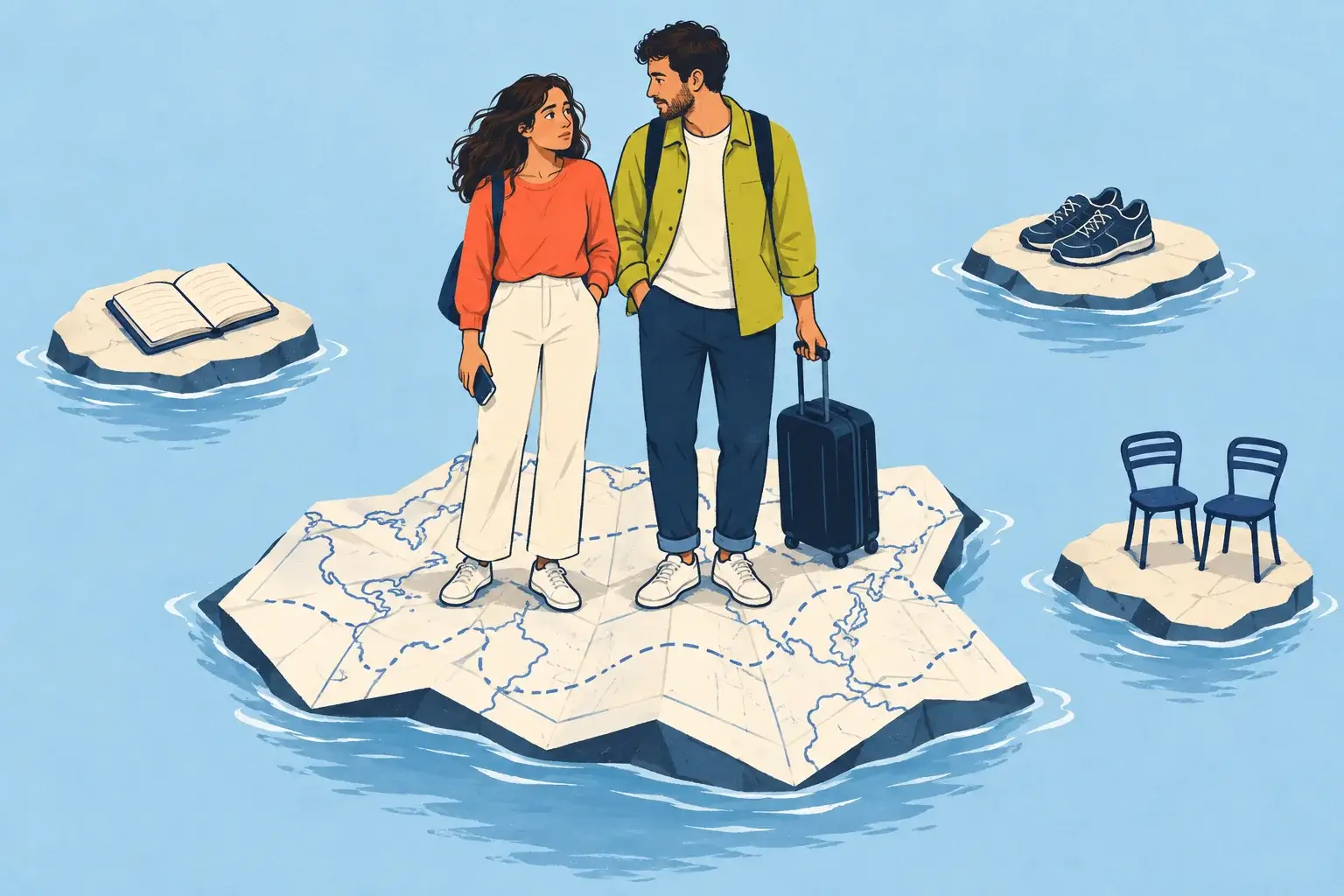
She has the life people move countries for. The flat with the good light. The job that justified the visa. A partner who is, by every visible measure, kind. And she is sitting across from me describing a fear so large she has started to wonder if she is unwell.

She is not unwell. She has simply run out of places to hide.

I want to tell you something that no relocation guide, no expat forum, no cheerful list of “ten tips for settling in” will tell you. You do not bring your anxiety abroad with you, folded between the towels. You bring yourself. And then the new country quietly removes everything that used to absorb the impact of you.

Back home, you had a mother who could read your face across a kitchen. A friend who would say “he is not worth it” before you had finished the sentence. A city that knew your name, a pavement that remembered your feet, a hundred small witnesses to the fact that you existed before this relationship and would exist after it.

Abroad, you have one person.

And you have quietly asked that one person to be your lover, your home, your family, your translator, your social life, your nervous system, and your evidence that you did not make a terrible mistake by coming here. No human being can carry all of that and still be someone you simply fancy on a Tuesday.

Most relationship anxiety abroad is misdiagnosed as a relationship problem. It is usually a belonging problem wearing a relationship's clothes.

· · ·

01Your partner became your whole country

There is a particular kind of person I have sat with many times. The visa changes. The accent changes. The city changes. The sentence does not. It is almost always some version of this: “I think I love him. But I cannot tell if I am staying for him, or because leaving him would mean I moved across the world for nothing.”

Read that again, because it is the whole trap. When you relocate for or with someone, the relationship stops being only a relationship. It becomes the receipt for an enormous decision. To doubt the love is to doubt the move. To doubt the move is to doubt yourself. So the stakes of an ordinary lovers' silence quietly inflate until a delayed reply feels like the collapse of your entire life abroad.

Illustration of a woman on a ladder examining a delayed text message through a magnifying glass while a man holds out his heart
Add a time difference and the anxious mind gets a new instrument to play. A reply that is six hours late is not late. It is, in a foreign flat at midnight, a verdict.

This is why expats so often arrive in therapy convinced they have developed a clinical disorder, when what they have actually developed is an honest reaction to having put all of their emotional eggs into one imported basket. The anxiety is not a malfunction. It is maths.

Watch · Recommended Resource
Anxious attachment, and why closeness can feel unsafe
· · ·

02The honeymoon abroad has a second act nobody mentions

For the first months, the move and the love wear the same face. The novelty of the city and the novelty of the person blur into one bright feeling, and you mistake it for proof. Look how alive I am. Look how right this was.

Then the city stops being a holiday and becomes a place where the bins must go out. The admin arrives. The language stays difficult. The friends do not materialise as quickly as the Instagram of it promised. And the person beside you, who was a thrilling co-conspirator in an adventure, is now also the only adult who speaks your emotional language for a thousand miles.

That is the moment the anxiety walks in. Not because anything has gone wrong. Because everything external that used to hold you has gone quiet, and the relationship is suddenly load-bearing in a way it was never designed to be.

A clinical note

A good relationship can feel more frightening than a bad one, because a good one gives you something to lose. Abroad, it can feel like the only thing you have left to lose. Safety does not always feel safe. Sometimes it feels like standing on the one floorboard that has not yet given way.

· · ·

03The shame of needing them this much

Here is the part people whisper, if they say it at all. They are not only frightened of losing the person. They are ashamed of how much losing the person would cost them. “What if they leave,” says the surface. “What if they leave and I am revealed as someone who built her entire existence on a man and a residence permit,” says the floor underneath.

Illustration titled the lie of complete independence, two people sitting apart insisting they need no one
Complete independence is not intimacy. It is loneliness with better posture, and a passport.

We have been sold a particularly modern lie, and expats swallow a double dose of it. Be brave enough to move across the world, but do not be so foolish as to depend on anyone once you arrive. Be open, but not needy. Be adventurous, but self-sufficient. It is a fantasy. You did not become a sealed unit the moment your plane landed. You became a person with fewer people, which is the opposite of needing less.

Healthy love involves dependency. You depend on honesty. You depend on repair. You depend on someone not using your isolation as leverage. That is not weakness. That is the actual texture of being a human who lives somewhere.

· · ·

04The reassurance loop, in a country that is not yours

So you ask. Are we okay. Do you still want this. Do you regret me. And for a moment the answer lands and the floor holds. Then the question grows back, slightly larger, because the thing you are really asking cannot be answered by a partner at all.

Tap each card —

“Do you still want this?”
what is said
Did I cross an ocean for something real?
what is underneath
“Are we okay?”
what is said
If we are not, I have nowhere here to land.
what is underneath
“Why were you distant?”
what is said
You are the only one here. Do not disappear.
what is underneath
“Are you sure about me?”
what is said
Tell me I am not foolish for needing you this much.
what is underneath

No partner can answer those questions, because they are not really about the partner. They are about home, and you have made a person stand in for a country. Reassurance answers the sentence. It does not reach the place the sentence came from.

· · ·

05Anxiety, or a signal worth respecting?

Now the question that keeps expats awake. What if this is not anxiety. What if some quiet part of me knows this was a mistake, the man or the move or both, and the panic is simply that knowledge trying to reach me.

The internet adores a clean answer here. Anxiety is loud, intuition is quiet. Anxiety is the past, intuition is the present. Tidy. Also not quite true to how a real life feels at two in the morning in a flat where the radiators make an unfamiliar sound.

A signalAn alarm
Gives you informationDemands your obedience
Says: look at thisSays: act now or you will not survive
Can tolerate being examinedHates reflection, wants you moving
Stays with you while you thinkText, ask, book a flight, end it tonight
Interactive reflection

Is it anxiety, or a signal worth listening to?

Six honest questions for anyone loving someone far from home. Not a diagnosis. A mirror.

This cannot see your life. If anything here resonates, it is worth exploring with a person, not a page.

Book a free consultation
· · ·

06When it is not anxiety, and being abroad is the trap

I have to be blunt here, because the gentle version of this has kept people stuck for years. Therapy language has become a beautiful way to talk yourself into staying somewhere that is harming you. You call it your anxious attachment when in fact he is unreliable. You call it your trust issues when in fact there has been secrecy and broken trust. You become so fluent in describing your own patterns that you stop noticing the other person's.

Illustration of a person arriving at a table dragging a trolley stacked with heavy old suitcases
Not every anxious relationship is a healthy one touching an old wound. Sometimes the relationship is the wound, and the suitcases are real.
Please read this carefully

Abroad, a controlling partner has tools they would not have at home. Your visa, your language, your money, your only friendships, your sense of whether anything here is normal. If you feel isolated and afraid, that is not your anxiety failing to behave. That is information. Please speak to someone safe, and if you are ever in danger, contact local emergency services or a domestic abuse helpline in your country. Couples work is never the answer where there is coercion or fear.

Watch · Related Resource
The anxious-avoidant pattern, and how it keeps two people stuck
· · ·

07The other one is exhausted too

Illustration of a couple sitting back to back with a shared speech bubble zipped shut above them
Often the couple is not fighting about the late reply or the changed plan. They are fighting about what those things have come to mean.

The partner of an anxious expat is frequently doing something quietly impossible. They are being asked to be an entire support network in one body. Every reassurance they give is real, and also never quite enough, because no person can be a country. So they begin to withdraw a little, to breathe, and that withdrawal becomes the very evidence the anxious one was scanning for. One reaches. One steps back. The reaching confirms the fear of being swallowed. The stepping back confirms the fear of being left here, alone, in the wrong time zone.

08What the work actually is

It is not learning to need your partner less. That is the avoidant fantasy, and it ends in a tidy, well-defended loneliness. The work is to stop making one person the entire country you live in. To build, slowly, a self you can return to, so that your partner is allowed to be a person again rather than the ground beneath your feet.

· · ·

09The question under the question

Illustration of a woman juggling a hanging mobile of relationship worries while her partner relaxes nearby
You did not move abroad to become smaller inside a relationship. You moved to become larger.

Under “is this anxiety or is this wrong” there is almost always a quieter, older question. Can I belong to a person when I no longer belong to a place? Can I let someone matter this much without handing them my whole self as collateral?

The real question is not only, will they hurt me. It is, will I abandon myself trying to make sure they never do.

Because love should not become a customs check you submit to nightly. And you did not cross a border to spend your one new life auditing another person's face for signs of leaving.

The goal is not to feel at home in them. The goal is to become a place you can come back to, in any country, in any silence.

Kita Tabachka, BACP-registered relational therapist
Written by

Kita Tabachka

I am a BACP-registered relational therapist. I work with individuals and couples, many of them living far from where they began, on relationship anxiety, attachment, intimacy and the strange business of building a self in a new country. The stories here are composites. The patterns are real. My writing is a door into the work, never a substitute for it.

More about my practice
From my shop · Therapy Tools Hub
Tools for anxiety, attachment and steadier love
Affordable, instantly downloadable tools I trust. Tap any cover to explore, or add it straight to your basket.
· · ·

Questions expats actually ask me

Because moving abroad removes the scaffolding that used to absorb your fears: old friends, family, a familiar city. Your partner ends up carrying the weight of your whole emotional life, and that concentration intensifies relationship anxiety and anxious attachment, even when the relationship itself is sound.
Very. When you relocate, one relationship quietly becomes your home, your social world and your proof that the move was worth it. That is an enormous amount of meaning for any partnership to hold, so the anxiety is a common and understandable reaction rather than a personal defect.
This is one of the hardest questions for people who moved for love. It helps to separate three threads: what belongs to your own history, what belongs to your partner's behaviour, and what belongs to the pressure of building a new life. A therapist with no stake in your decision can help you tell them apart.
It does not create it, but it can powerfully activate it. Relocation strips away the people and places that used to regulate you, so a pattern that felt manageable at home can become overwhelming abroad.
Dependence on its own is not danger. But isolation combined with control over your money, language, documents or friendships can make a harmful relationship far harder to leave. If you feel unsafe, please contact local emergency services or a domestic abuse helpline in your country.
Yes. It can help you rebuild a self that does not rest entirely on one person, reduce reassurance seeking, work with the attachment wounds underneath, and learn to tell anxiety from a genuine signal, which is especially confusing when you have uprooted your whole life.

Join the conversation

If you have lived this, say so. Your words may be the thing a stranger at midnight needed to read.

Moderated with care. Be kind. This space is for stories, not advice.

No comments yet. Be the first to share what this brought up for you.