The Grounding Room
Four steps for a racing mind: one colour, one surface, one sound, one comfort. Breathing is optional. For the night the reply has not come and you have already written tomorrow three times.
Read about this roomA little gift from Kita
Quiet your anxiety. Eleven free rooms for when your mind is still going long after the day is done.
Pick one thing that feels doable. Grounding for anxiety, anger regulation, calming music, musical drawing and gentle play, each room made for one moment by a BACP-registered therapist.
No sign-up. Sound is optional.

Made and reviewed by Kita Tabachka, BACP-registered relational therapist (reg 409623). Last reviewed 7 November 2026.

At your own pace
Choose the line that sounds like you, or take a look around the rooms below.
Research & a place to play
Oxford researchers found promising results from a structured intervention involving Tetris for intrusive trauma memories. The intervention included specific memory-related procedures and mental-rotation instruction. Ordinary gameplay on its own has not been shown by that study to deliver the same result.
You can choose to play the official game for enjoyment or a change of attention. You do not need to deliberately recall anything distressing. If intrusive memories are troubling you, discuss support and the research with a qualified therapist.
The game opens on the official Tetris website in a new tab, with its own sound, pace, privacy settings and possible advertising. This link is not a trauma treatment or an endorsement by Oxford or Tetris. For untimed play here, try Quiet Blocks.
Each room is built for one moment, with a short page of its own: what it is for, the steps, what it is not, and what to do afterwards.
Four steps for a racing mind: one colour, one surface, one sound, one comfort. Breathing is optional. For the night the reply has not come and you have already written tomorrow three times.
Read about this roomFor the three minutes before you press Send. Four steps, a drawing page, a block puzzle, and a script to say out loud: I am too wound up to talk constructively. I need a break, and I will suggest a time to return.
Read about this roomA two-minute timer and the next visible action. Open the document. Write one sentence. Nothing restarts on its own.
Read about this roomFor the thought you keep turning over with nothing new in it. Name it if naming helps, come back to the room, let the thought be a thought, choose one small action.
Read about this roomThe only room with nothing to do. No sound, no timer, no exercise. A dark, still view, a line or two drifting past, and permission to stay.
Read about this roomThree silent steps for the gap between meetings. Let one demand wait, look beyond the screen, choose one next action. Nobody on the next call would know.
Read about this roomTwelve complete classical recordings, with rain, sea, wind, fire, a deep hush or a slow heartbeat underneath. The music carries on when you lock your phone.
Read about this roomFor restless anxiety. Tap a constellation for notes, play the piano and watch every note plant a flower, move shapes. Movement is the method.
Read about this roomEvery line you draw makes a note. For the feeling which arrives before the sentence. Nothing is saved.
Read about this roomAn untimed block puzzle. Nothing falls until you move it, and there is no losing. A problem small enough to solve at 3am.
Read about this roomFor restless, ADHD-type attention and the thoughts which go round at night. Tiles carrying those thoughts drift down; touch one and it melts into a piano note. Type your own and let it fall. No score, no losing.
Read about this roomSomeone you were talking with has taken a pause here and sent you this room. A pause is for creating space, not punishing. You are welcome to use it too.
Try this first
Two minutes, four small steps. Nothing to get right.
Choose a shape, or draw freely. Round shapes soothe. Straight shapes give strength or let tension out.
No sound playing.Touch the canvas to begin.
One finger, any shape. The canvas stays still.
Choose a ready-made sound or make your own.
These are complete performances by real musicians. Nature textures and touch instruments are digitally made. Performer and licence credits are in About these tools & music credits on the room selection page.
For winding down: try Rain at night or Sleepy strings, keep the volume low, then dim the canvas. You can still draw. Sound pauses if you leave this page or your browser suspends it.
Bilateral mirrors one movement on both sides. Two hands lets two fingers draw independently, in different colours. Try loops or a figure eight. Headphones make left and right sound easier to hear; they are optional. Alternation follows your drawing and stops when you stop making notes.
These are creative sensory tools, not EMDR treatment or a treatment for insomnia. Choose what feels comfortable. Stop or switch to quiet whenever you want.
Sounds are original digital textures and instruments, not field recordings. Your drawing stays in this visit and clears on reload. Keyboard: arrows draw; Space makes a dot; Tab moves to the controls.
Fill the gap. Tap Place to clear your first row.
Move and rotate the shape, then press Place. Complete a row to clear it. Your pace means nothing falls until you move it. A gentle break reminder pauses play after three minutes.
Keyboard: focus the board, use arrows to move and rotate, Space to place, P to pause. Touch controls stay below the board.
Quiet Blocks is an original play activity. It is not Tetris or the structured intervention studied for intrusive memories. Open official Tetris in a new tab, or read the Oxford research. The external game has its own sound, pace and privacy settings.

You can draw it, doodle, move shapes or take a moment before responding. No perfect picture. No right feeling.
1 of 5
If you have typed it, paste it here and keep it out of the chat. The room holds it for twenty minutes, the time a flooded body needs to settle. One version is enough. Do not add to it.
It stays on this phone only. Nothing is sent.
Press and hold the circle and squeeze your fists. After five seconds, let go and breathe out slowly for ten. Five rounds. Cold water on your face or wrists helps too.
Round 1 of 5
Picture the scene from across the room, as if you were watching someone else. Then answer one question, using your own name.
Why are you angry?
Anger is often the feeling on top. Choose the one closest to what is underneath, or leave it open.
The first sentence decides how the conversation goes. Build one which says what you felt and what you need, with no blame in it.
Pause the message or conversation if it is safe. Put down anything you might throw. Give yourself and other people space. You do not have to resolve this while you feel close to reacting.
If someone may be hurt, step away where safe and seek immediate help. If anger repeatedly leads to threats or harm, professional support matters.
A place to begin
That was the whole room. Stay as long as you like. Choose another room
A need or boundary, perhaps
Choose only if a word fits. You can leave this unanswered.
2:00
A word can be enough
You can name it privately, or choose a word here. You do not need to describe the thought.
You can skip naming and stay with the room around you.
One next action
This is general stress support. If intrusive thoughts lead to repeated checking, reassurance seeking or rituals, seek an assessment. You do not need to repeat this exercise until a thought feels safe. About support for OCD.
Sounds to stay inside
Pick one or stack two. Each sound is made here in your browser as you listen, so nothing downloads and nothing loops. It keeps going when you lock your phone.
Nature sounds and steady low noise have the most research behind them for settling the body. The heartbeat, the bowl and the drifting tone are pleasant, with thinner evidence. Nothing here is tuned to a healing frequency. If a sound adds to the noise, switch it off.
Touch the colours for ripples, or expand the piano to play.
How true does your loudest thought feel right now?
1 is not true at all, 5 is completely true. Optional. Your answer stays on this device.
What is loud tonight?
Tap a thought to melt it. Hold it and choose the word for what it is doing. Your own words stay on this screen for this visit only; nothing is saved or sent.
If the thought is about ending your life, this room is not the place for it. Samaritans answer any hour on 116 123 (UK and Ireland).
Choose from six gentle textures that alternate between your left and right ear. Headphones let you hear the movement.
An optional sensory rhythm, not an EMDR session. Stay with the room around you, rather than deliberately bringing up difficult memories. Stop if you feel uncomfortable, dizzy or more unsettled.
Anger regulation: These steps draw on NHS anger guidance and a 2024 review of anger-management activities. The evidence supports reducing arousal rather than escalating it. Drawing and block play here are optional creative activities, not clinically validated anger treatments. Colours identify rooms and invite personal preference; they do not diagnose or treat emotions.
Why these colours and shapes? A research review found that people often associate blue and green with lower-arousal emotions. An association does not prove that looking at a colour will regulate your emotions. Our palettes, rounded shapes and room symbols are design choices for orientation and personal preference, not colour therapy or a brain-stimulation treatment. You can change colour, light and movement. Read the colour and emotion review.
The Steadying Room: original prompts informed by WHO guidance on grounding, naming difficult experiences, stepping back from thoughts and acting on what matters. They are not a reproduction of the full programme, or a treatment for intrusive thoughts. WHO: Doing What Matters in Times of Stress.
The ADHD routes use adjustable noise, reduced distractions, short periods of focus and optional movement breaks, consistent with NICE guidance on environmental modifications. The anxiety route offers self-paced grounding inspired by NHS inform and optional comfortable breathing consistent with NHS guidance. These sources inform the design; they do not validate this website or a particular recording as a treatment.
This is a sensory space for enjoyment and relaxation, not a treatment for anxiety, ADHD or trauma. Some people find these experiences soothing; others prefer quiet. You can stop at any time. Start at a low device volume. Audio starts only when you choose it. Music keeps playing if you lock your phone or switch tabs, with play and pause on your lock screen, and it never starts on its own. The next recording plays only if you enable Continue through this collection.
Alternating sound is sometimes called bilateral stimulation. EMDR is a structured therapy delivered by a trained clinician, not simply alternating sounds. About EMDR therapy. The sound bath is a listening experience, not a claim about energy fields or healing frequencies.
Recordings use Wikimedia's MP3 transcodes, with no musical edits. Performers do not endorse this site. The generated visual accompaniment is offered under CC BY-SA 3.0. Tap-to-play themes are simplified digital arrangements of public-domain Beethoven compositions.
The room records no taps, sound choices or personal reflections. Route choices and timers reset when you reload. Existing site privacy and cookie settings still apply. Audio files are served from this website.
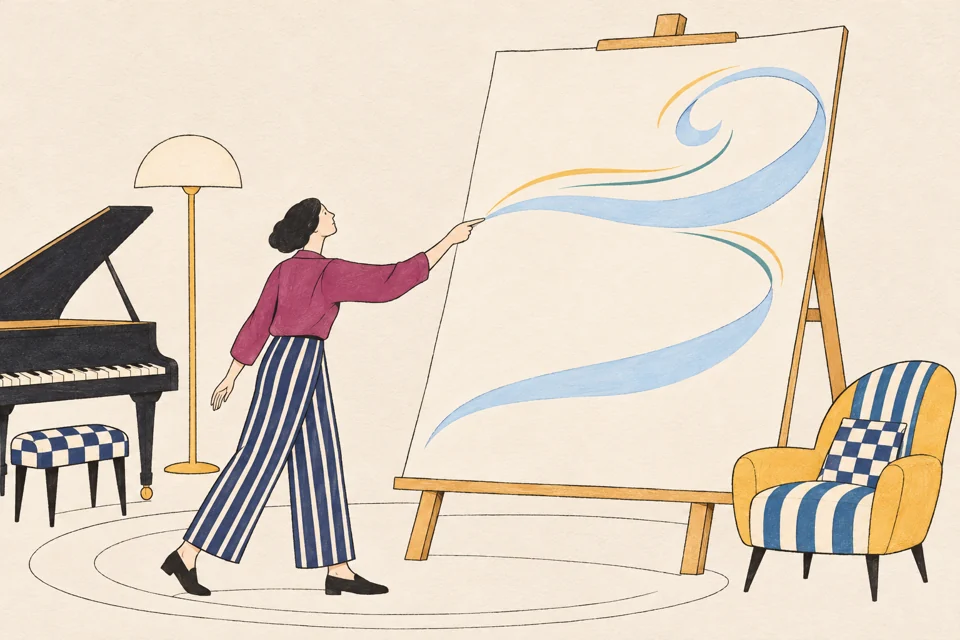
A little gift from me, Kita, to you.
A busy mind. A difficult feeling. A day that has asked a lot. I made a place where you can draw, play, listen or find a little quiet.
Open The Pause RoomFree to explore. No sign-up. Come as you are.
The pointer shows where you land.
When all you can say is that you feel off, try a word and see if it fits. You can feel several things at once.
Open the full Feelings Wheel guide