INDIVIDUAL THERAPY · FINDING WORDS
What if I have nothing to say in therapy?
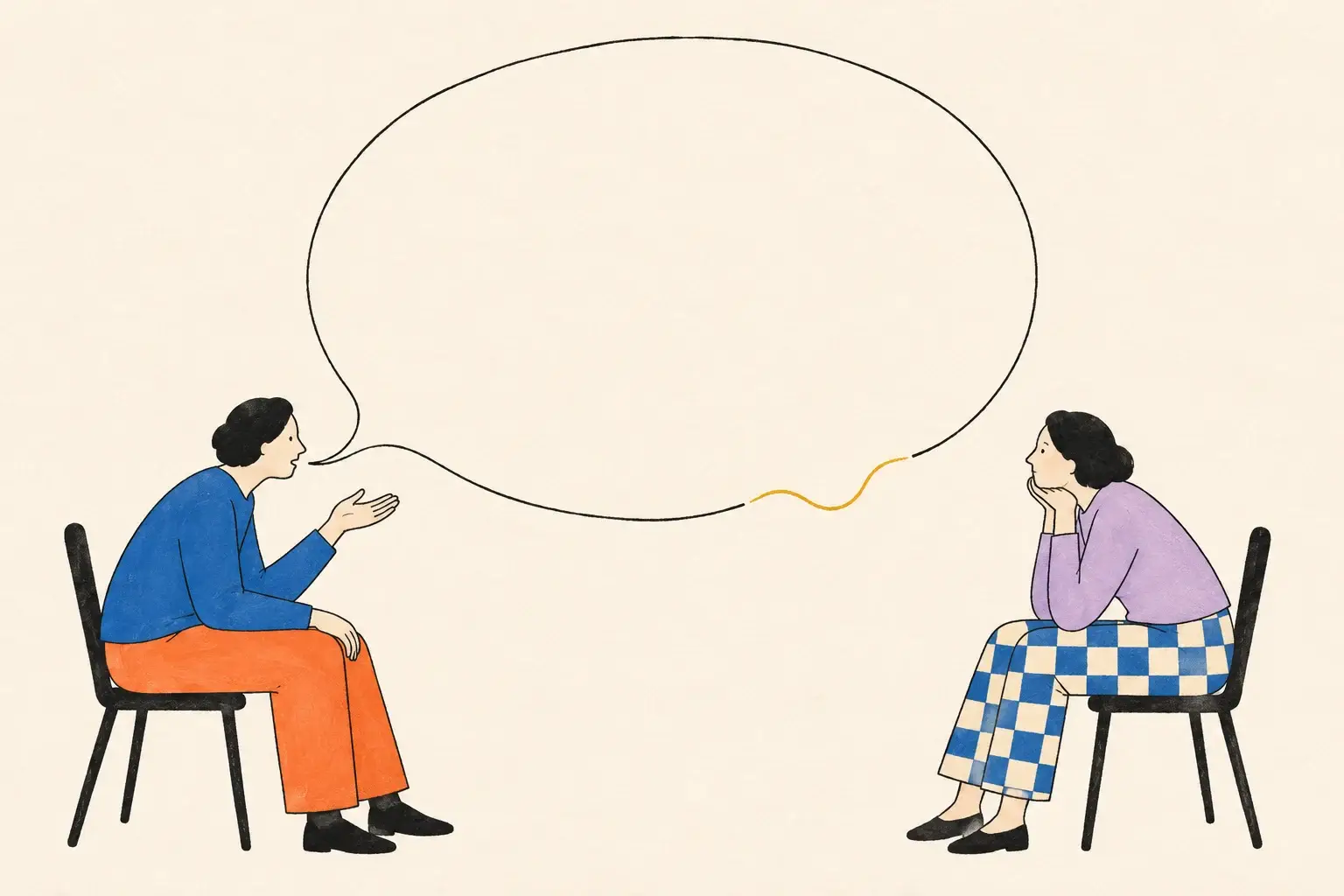
If you have nothing to say in therapy, you can start by saying exactly that. You might describe an ordinary moment from your week, notice how it feels to be in the session, or ask your therapist for a question to help you begin. You do not need a crisis or a prepared explanation to make the time worthwhile.
Picture closing a work call where you answered every question clearly. A few minutes later, your therapist asks how you are, and your mind goes blank. Having words for your responsibilities is not always the same as having words for yourself.
You may be trying to give the right answer
Perhaps you want to be concise, interesting or easy to help. You have already discarded three things because they sound trivial. The disagreement over dinner was too small. The loneliness was too familiar. You cannot explain the irritation, so you leave that out as well.
Notice the standard you are applying before you speak. Does an experience have to be dramatic, logical or neatly resolved before it deserves attention? That question may itself be worth bringing into the session.
BACP describes counselling as a place to explore thoughts, feelings, relationships and situations you find difficult. What you discuss depends on your needs and the therapist’s approach. It is not an examination with a hidden model answer.
Choose a moment rather than a life summary
Think of one point in the week when something shifted. You saw a name on your phone and delayed replying. You agreed to a favour, then felt annoyed. You got home and could not face anyone asking what was wrong.
You do not have to know why. Describe what happened, what you noticed and what you did next. A small scene gives you both somewhere to begin without requiring you to explain your whole history.

Three unfinished sentences to bring with you
Before the session, jot down a few words after each of these prompts. Stop after a couple of minutes; this is an invitation, not homework you must complete perfectly.
- “Something I nearly mentioned last time was…”
- “A moment that stayed with me this week was…”
- “What feels difficult about talking here today is…”
You could read one aloud: “I keep thinking I should have something more important to say. Could we start there?” Or simply: “My mind feels blank. Could you ask me something more specific?”
If the words come to you in another language first, you might find this piece on choosing a language for therapy useful.
You can ask for a different pace
Some pauses help you notice what you feel. Others may leave you confused, uncomfortable or unsure what is expected. You are allowed to say which is happening. A therapist cannot reliably infer what silence means for you.
If you repeatedly leave feeling that nothing important was addressed, discuss that too. Ask how you will decide what to focus on and review whether the work is helping. You do not have to perform gratitude for a way of working that does not fit.
For readers in Poole or Oxford, the UK therapy page explains my online service. If you are in Sofia, we also check the arrangements for working across borders.
You can explore individual therapy or arrange a free consultation. If making contact is the difficult part, these first-email examples may help. You can begin before you know how to explain everything.