Both PDF workbooks + fillable worksheets · £19.99 Save £9.99 when you buy the pair.Both workbooks · £19.99PDFs + fillable worksheets · Save £9.99See the bundle

The Pause Room · Room 1 of 11

The Colour and Sound Room

When you feel it but cannot quite say it.

Free. No sign-up. Sound is optional. Made by Kita Tabachka, BACP-registered therapist.

The Colour and Sound Room illustration: When you feel it but cannot quite say it.

Your room

Try this first

Sounds to stay inside

Rain, sea, a low hush.

Pick one or stack two. Each sound is made here in your browser as you listen, so nothing downloads and nothing loops. It keeps going when you lock your phone.

Start with a mix:

Nature sounds and steady low noise have the most research behind them for settling the body. The heartbeat, the bowl and the drifting tone are pleasant, with thinner evidence. Nothing here is tuned to a healing frequency. If a sound adds to the noise, switch it off.

Your sensory canvas

Touch the colours for ripples, or expand the piano to play.

Your room is quiet. Choose a room when you are ready.

Sound & visual settings
Left-to-right sound

Choose from six gentle textures that alternate between your left and right ear. Headphones let you hear the movement.

An optional sensory rhythm, not an EMDR session. Stay with the room around you, rather than deliberately bringing up difficult memories. Stop if you feel uncomfortable, dizzy or more unsettled.

About these tools & music credits

Anger regulation: These steps draw on NHS anger guidance and a 2024 review of anger-management activities. The evidence supports reducing arousal rather than escalating it. Drawing and block play here are optional creative activities, not clinically validated anger treatments. Colours identify rooms and invite personal preference; they do not diagnose or treat emotions.

Why these colours and shapes? A research review found that people often associate blue and green with lower-arousal emotions. An association does not prove that looking at a colour will regulate your emotions. Our palettes, rounded shapes and room symbols are design choices for orientation and personal preference, not colour therapy or a brain-stimulation treatment. You can change colour, light and movement. Read the colour and emotion review.

The Steadying Room: original prompts informed by WHO guidance on grounding, naming difficult experiences, stepping back from thoughts and acting on what matters. They are not a reproduction of the full programme, or a treatment for intrusive thoughts. WHO: Doing What Matters in Times of Stress.

The ADHD routes use adjustable noise, reduced distractions, short periods of focus and optional movement breaks, consistent with NICE guidance on environmental modifications. The anxiety route offers self-paced grounding inspired by NHS inform and optional comfortable breathing consistent with NHS guidance. These sources inform the design; they do not validate this website or a particular recording as a treatment.

This is a sensory space for enjoyment and relaxation, not a treatment for anxiety, ADHD or trauma. Some people find these experiences soothing; others prefer quiet. You can stop at any time. Start at a low device volume. Audio starts only when you choose it. Music keeps playing if you lock your phone or switch tabs, with play and pause on your lock screen, and it never starts on its own. The next recording plays only if you enable Continue through this collection.

Alternating sound is sometimes called bilateral stimulation. EMDR is a structured therapy delivered by a trained clinician, not simply alternating sounds. About EMDR therapy. The sound bath is a listening experience, not a claim about energy fields or healing frequencies.

Recordings use Wikimedia's MP3 transcodes, with no musical edits. Performers do not endorse this site. The generated visual accompaniment is offered under CC BY-SA 3.0. Tap-to-play themes are simplified digital arrangements of public-domain Beethoven compositions.

The room records no taps, sound choices or personal reflections. Route choices and timers reset when you reload. Existing site privacy and cookie settings still apply. Audio files are served from this website.

About this room

I keep paper and pens on the table in my therapy room. When a sentence will not come, a hand often knows what to do.

Why I made this room

I studied art, and I work with it every week. I have watched people draw what they had no words for, and I have watched their shoulders drop while they did it. We each have our own way of saying what is inside us. Mine is art: drawing, scribbles, words, music.

This room is my gift to you. It costs nothing and asks for nothing. Come in, share a few minutes with yourself, and let your hands move.

What happens on the page

The page is dark and your line glows. Tap Mirror, and whatever you draw on one side appears on the other at the same moment, as if both hands were drawing. Each line makes a sound. Draw fast and hard, and the sound comes fast, loud and low. Draw slowly, and a few soft notes answer.

When you lift your finger, the room draws a quiet line back inside yours. After two or three minutes the sound slows by itself, and most hands slow with it.

The shapes, and where they come from

The shapes under the page are old. Carl Jung wrote about forms like the circle and the cross as shapes people in many cultures have drawn for thousands of years. I learned to work with them through Guided Drawing, the method Cornelia Elbrecht developed. You draw one shape again and again with both hands, and you pay attention to your body while you do it.

Round shapes tend to soothe. Straight shapes tend to give strength, or give tension a way out. No shape has a fixed meaning. Your body decides what it needs today.

  • Circle. Round and complete. Draw it when you feel scattered and want to feel in one piece.
  • Bowl. A curve open at the top. Rock along it from side to side. Many people feel held by this movement.
  • Spiral. Wind inwards to gather yourself. Wind outwards to let something leave.
  • Figure eight. A loop with no end, crossing in the middle. Draw it when you feel stuck, or pulled in two directions.
  • Wave. Up and down at the pace of slow breathing. Let it slow your breath with it.
  • Upright line. Up and down, in line with your spine. Draw it to feel yourself standing tall.
  • Level line. Side to side, at the level of the ground. Draw it to rest and settle.
  • Cross. Upright and level meeting at one point. Draw it to find your centre and say: I am here.
  • Triangle. Three firm corners. Draw it when you need direction.
  • Square. Four sides, closed. Draw it when you need a boundary and a safe place inside it.
  • Zigzag. Start sharp and quick, then let each round get slower and rounder. Anger settles when the hand slows.
  • Dot. One point, tapped in a steady beat. Here, here, here.

Why you repeat the shape

One circle is a drawing. Thirty circles are a rhythm. When you repeat a shape, your hand stops planning and your body takes over: the shoulders, the breath, the pressure of your fingers. I see it most weeks. The first rounds come tight and quick. After a while the line gets rounder and slower, and people tell me something in their jaw or chest has let go.

Give a shape two minutes before you judge it. Close your eyes if you feel safe to. If a shape makes you more tense, stop and choose another.

How to begin

Tap Guide me for two minutes and follow the four steps. Or choose a colour, choose a shape, and follow the gold dot as it slows. Tap Mute drawing for silence. Tap The room answers if you want your lines left alone. Tap Keep this picture to save it to your phone.

What stays private

Your picture stays on your own device. It is still there when you come back, until you tap Clear. Nothing you draw is sent to me or to anyone.

What this room is not

This room is a place to move and feel. It does not replace art therapy or Guided Drawing with a trained practitioner, and the research on drawing for anxiety is still small. Colours and shapes are no test, and blue does not mean sad. If the feeling you keep drawing is old, and it arrives in the body before the mind, trauma and attachment therapy works with this gap between feeling and words.

Afterwards

Look at what you drew before you clear it. Go back to the place in your body where you started. One word for the picture, if a word comes.

Questions people ask

Does the drawing get saved anywhere?

Only on your own phone or computer, so it is there when you come back. Nothing is uploaded or sent. Tap Clear and it is gone.

Why does the line make a sound?

Sound lets you hear your own movement. Fast, hard lines sound fast, loud and low. Slow lines get a few soft notes. If you prefer silence, tap Mute drawing.

What are the shapes for?

Each one is a movement to repeat with your hands. Round shapes tend to soothe. Straight shapes tend to give strength or let tension out. Choose by what your body wants, and change if it does not help.

Is this art therapy?

No. Art therapy and Guided Drawing are delivered by trained practitioners. This is a private drawing page I made for the moment before words.

Kita Tabachka

Written and reviewed by Kita Tabachka, BACP-registered relational therapist (reg 409623), more than 5,000 online sessions with individuals and couples. Last reviewed 11 November 2026. About Kita
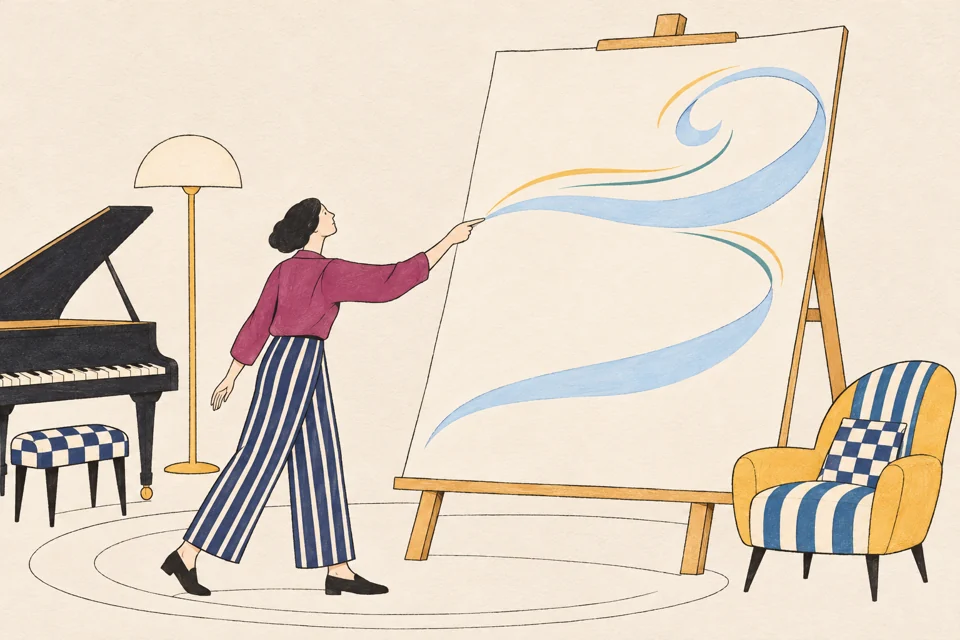
An illustrated person turning a fingertip movement into colourful ribbons

A little gift from me, Kita, to you.

For the moment
you need this.

A busy mind. A difficult feeling. A day that has asked a lot. I made a place where you can draw, play, listen or find a little quiet.

Open The Pause Room

Free to explore. No sign-up. Come as you are.

What am I feeling?

When all you can say is that you feel off, try a word and see if it fits. You can feel several things at once.

Open the full Feelings Wheel guide

Joy
  • Delighted
  • Amused
  • Playful
  • Proud
  • Grateful
  • Excited
  • Hopeful
  • Inspired
  • Curious
  • Eager
Sadness
  • Disappointed
  • Dejected
  • Heartbroken
  • Grief-stricken
  • Wistful
  • Lonely
  • Homesick
  • Discouraged
  • Bereft
  • Melancholy
Anger
  • Irritated
  • Frustrated
  • Resentful
  • Furious
  • Indignant
  • Bitter
  • Impatient
  • Aggrieved
  • Offended
  • Exasperated
Fear
  • Uneasy
  • Apprehensive
  • Anxious
  • Worried
  • Alarmed
  • Startled
  • Panicked
  • Full of dread
  • Vulnerable
  • Intimidated
Shame & guilt
  • Embarrassed
  • Ashamed
  • Guilty
  • Remorseful
  • Humiliated
  • Self-conscious
  • Exposed
  • Regretful
  • Mortified
  • Contrite
Surprise
  • Astonished
  • Amazed
  • Awestruck
  • Bewildered
  • Confused
  • Perplexed
  • Taken aback
  • Intrigued
  • Stunned
  • Unsettled
Disgust
  • Repulsed
  • Revolted
  • Disdainful
  • Contemptuous
  • Put off
  • Squeamish
  • Appalled
  • Averse
  • Disturbed
  • Disapproving
Connection
  • Affectionate
  • Tender
  • Fond
  • Compassionate
  • Understood
  • Accepted
  • Comforted
  • Trusting
  • Loved
  • Appreciated
Calm & relief
  • Relieved
  • Peaceful
  • Content
  • Settled
  • Safe
  • Reassured
  • Relaxed
  • Grounded
  • At ease
  • Rested
Mixed or unclear
  • Numb
  • Overwhelmed
  • Torn
  • Bittersweet
  • Restless
  • Detached
  • Flat
  • Conflicted
  • Ambivalent
  • Shut down

Message on WhatsApp