Couples · Life abroad
My partner wants to move abroad. I am not sure I do.
One of you has started saying "when we go". The other has started going quiet. This is for the couple stuck between a move one person longs for and the other is not ready to agree to, and for the person asking whether to move abroad for a partner at all.
A Thursday night in Leeds, a browser tab open to flats in Lisbon
He turns the laptop towards you on the sofa. A two-bedroom flat near the river, a balcony, a price lower than your rent. He has been sending these for a month. You say it looks lovely, because it does, and you go to put the kettle on so you do not have to say the next thing.
The next thing is some version of: I do not want to go. Or: I am not sure. Or: I want to want this and I do not. The last time you came close to saying it, his face closed, and you both spent two days being careful with each other.
So the tab stays open and the subject stays half-open with it. Every flat he sends is a question. Every change of subject is an answer he hears and you have not given.
The conversation which never finishes
Couples who come to me with this rarely describe a row. They describe a conversation they have had forty times and never once completed. One partner raises the move. The other asks a practical question about visas, parents, work, the dog. The first hears the question as a no in disguise and pushes harder. The second hears a decision already made without them, and digs in. Both go to bed unheard.
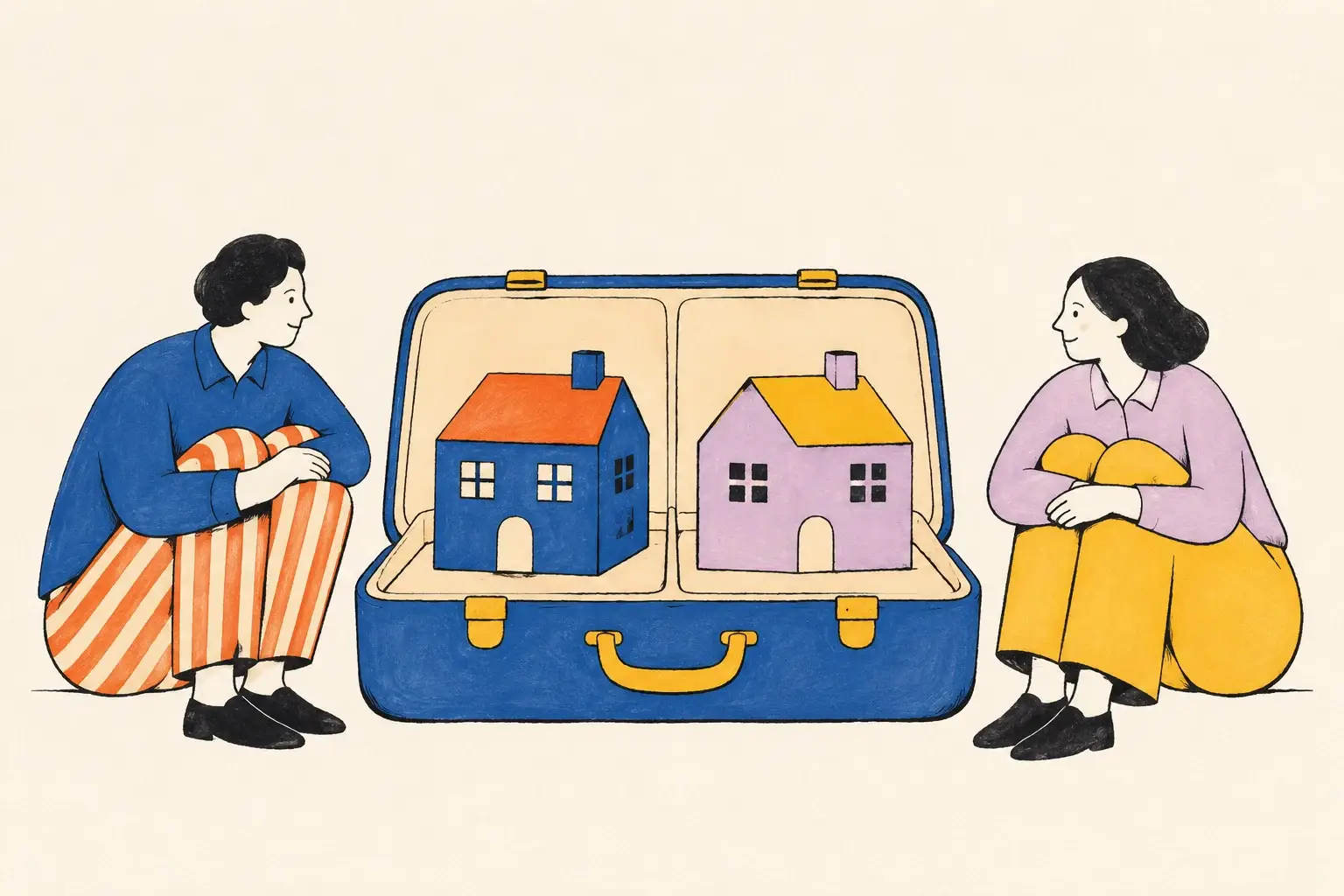
Each of you is protecting something. The one who wants to go is protecting a hope, often an old one, from being talked out of existence by sensible questions. The one who is not sure is protecting a life, and a self, from being packed into boxes before anyone has asked whether it fits.
Neither protection is wrong. The problem is the shape of the exchange. You are trying to settle the biggest decision of your shared life in the ten minutes you use to decide what to eat.
What sits underneath on each side
For the partner who wants to move, the country is seldom the point. Underneath is a longing for a life they feel is waiting somewhere else, or a wish to leave a version of themselves they have outgrown, or a pull towards their own home country, kept quiet for years because the relationship lived in yours.
For the partner who is not sure, the list is longer and heavier than it sounds. Parents getting older. A career which took a decade to build and would not come with you. Friends who know your history. The fear of arriving as the one who followed, with no job and no reason of your own to be there. And under those, a quieter fear: if I go for you, what do you owe me, and what happens to us if it fails.
There is also power in the room, and it helps to name it. The partner with the job offer, the passport or the family abroad holds the clock. The other partner holds the veto.
This is a common road. In InterNations' 2026 Expat Insider survey of close to 7,800 expats, 11 per cent said their main reason for moving was love or living in their partner's home country, and a further 6 per cent had relocated for a partner's job. Of those who moved for a partner's career, close to 73 per cent were women [1]. Trailing partner resentment is what the unfinished version of this conversation tends to become two years later.
Three versions of the same decision
A job offer with a date on it
Someone else's calendar is now running your relationship. Relocation packages come with start dates measured in weeks, and a shared decision becomes a yes or no under deadline. Separate the two questions the deadline has welded together: do we want to live abroad, and do we want this particular offer. A no to the offer is not a no to the life.
Your partner's home country
In cross-cultural couples, the move home carries years of unspoken weight. Your partner left their country for you, or for work, and has lived in your language and near your family since. Their wish to go back is also a wish to stop being the one who adapted. Your hesitation is also a fear of taking on the same role yourself. Cross-cultural couples therapy often starts exactly here.
A dream with no date
The hardest version to talk about, because nothing is forcing the conversation. One partner keeps returning to the idea. The other keeps letting it pass and hopes it fades. It does not fade. It goes underground and comes back as feeling trapped on one side and dismissed on the other. The practice below is for you most of all.
The conversation to have first
Before any decision, before another flat gets sent, have one conversation whose only purpose is to be understood. An hour. No laptop. Nobody proposes anything.
- Ten minutes each on what the move means. The partner who wants to go speaks first, for ten minutes, about what the move would give them and what staying costs them. Not the plan. The meaning. The other listens, then says back in their own words what they heard, until the speaker says yes, you have it. Then swap. The partner who is not sure speaks about what they would lose and what they fear, with the same rule: no interruption, and a full reflection back before anything else.
- Twenty minutes on conditions, not verdicts. Each of you finishes two sentences aloud and the other writes them down. For a yes, I would need. A no would cost me. Be specific. A return date. A job lined up before departure. Whose career goes next. A flight home every three months. Written conditions turn a wall into a set of doors.
- No decision for a week. Agree it out loud. For seven days neither of you raises the move. Then you come back to the two lists, not to the argument. Most couples find the lists have already moved the conversation somewhere new.
Two rules make this work. First, the word "if". It is an "if we go" conversation, not a "when" and not a "never". Second, nobody says "if you loved me" or "you are holding me back" or "you always get your way". Those sentences end conversations. Write them down and bring them to the lists.
One exception to all of this. If the move is being used to take you away from your own people, your own money or your own say, or if you are afraid of what your partner will do when you refuse, this is not a decision to negotiate at the kitchen table. Talk to someone you trust first. In the UK, Refuge runs the National Domestic Abuse Helpline on 0808 2000 247, day and night. If you are in immediate danger anywhere, use your local emergency number.
Moving for a partner, or with one
People ask me whether they should move abroad for their partner. The honest answer is a change of preposition. Moving for a partner is a loan, and loans come due. Two years in, in a flat the other person chose, the loan gets called in during an ordinary row about the washing up. Moving with a partner means you found one reason of your own to be there before you went, even a small one, and you both said the costs out loud.
The moves which go well share a few features. The partner who followed had something to do in the first ninety days which was not unpacking. The couple had agreed, before leaving, what would happen if it did not work. And the partner who wanted the move stayed curious about the other's loss after arrival, rather than relieved the argument was over. The first ninety days abroad as a couple sets out what those weeks ask of you both.
The moves which go badly share features too. A yes given to end the conflict. A partner who agreed and then went quiet. Anxiety which arrives after landing and attaches itself to the relationship, the only familiar thing left. More on the last of these in relationship anxiety after moving abroad.
And sometimes a good conversation ends with the news one of you wants a life the other does not. Painful, and still information, and better learned over two lists at your own table than in a country where one of you has no way back.
When to talk to someone
Come and talk if you have had this conversation more than a handful of times without it going anywhere. If one of you has started agreeing in order to stop the subject. If there is a deadline and neither of you is able to be in the same room with it. Or if you have already moved, and the decision is being refought in a new country with the resentment showing.
This is part of the work I do in couples therapy, online, with couples in the UK and couples where one or both of you already live abroad. Sessions are 70 minutes at £100, and the first 15 to 20 minute consultation is free, for both of you together. If you are the one who moved and want a room of your own to think in, I also work with individuals as an expat therapist. Before we begin I confirm your location is one I am able to work with, and any legal or ethical limits which apply where you live.
Questions people ask
My partner wants to move abroad and I don't. Does one of us have to give in?
Not at first, and giving in is the worst way to settle it. Most couples reach this point having argued about the plan without ever hearing what the move means to each of them. Start there, with the hour-long conversation above, and with written conditions rather than verdicts. Some couples find a version of the move both of them want. Some find a timeline which works. Some find out one of them wants a different life, which is hard to learn and better learned early. A yes given to end the conflict is the one outcome which reliably costs the relationship later.
Should I move abroad for my partner?
Move with your partner, not for them. The difference is whether you have at least one reason of your own to be in the new place, even a small one, and whether the two of you have said the costs and the exit plan aloud before you go. If you are going purely to keep the relationship, the move becomes a debt, and debts between partners get called in during ordinary arguments. If you have your own reason, a plan for the first three months and an agreed answer to the question of what happens if it does not work, the move stands a far better chance, and so do you.
Is it normal to resent my partner for wanting to move abroad?
Yes, and the resentment usually means something has gone unsaid rather than something has gone wrong with you. People resent what they feel they cannot refuse. If every mention of the move lands as a decision already made, you are being asked to agree to something rather than choose it, and resentment is the honest response. Say the thing underneath instead: I feel I am being asked to say yes, and I do not feel I am being asked what I want. One sentence like this changes the conversation more than another week of being careful with each other.
How does online couples therapy work when one of us already lives abroad?
We meet by secure video, the two of you together, at a time which fits your time zones. If you are in different countries, each of you joins from where you are. Sessions are 70 minutes at £100, and the first 15 to 20 minute consultation is free. Before we begin I confirm each of your locations is one I am able to work with, and any legal or ethical limits which apply there. The early sessions are usually about getting the unfinished conversation finished, with both of you heard, before anything about the move itself is decided.
Sources and notes
- InterNations, Top Reasons for Moving Abroad in 2026, from the 2026 Expat Insider survey of close to 7,800 expats: 11 per cent moved for love or to live in their partner's home country, 6 per cent for a partner's job, and close to 73 per cent of those who moved for a partner's job were women. Percentages are rounded as published.
The couple in this article is a composite and is not drawn from any one person's therapy. This page offers general information, not an individual assessment, legal or immigration advice, or emergency support.
If you are afraid of your partner or cannot keep yourself safe, seek urgent help. In the UK, the National Domestic Abuse Helpline is 0808 2000 247. Elsewhere, use your local emergency or crisis service.