Relationship anxiety · A practical short read
Anxious when your partner doesn’t reply?
Feeling anxious when your partner does not reply can turn an ordinary pause into a painful story about rejection. A useful first step is to separate what you know from what you fear, then decide whether you need to settle, communicate or address a repeated problem.
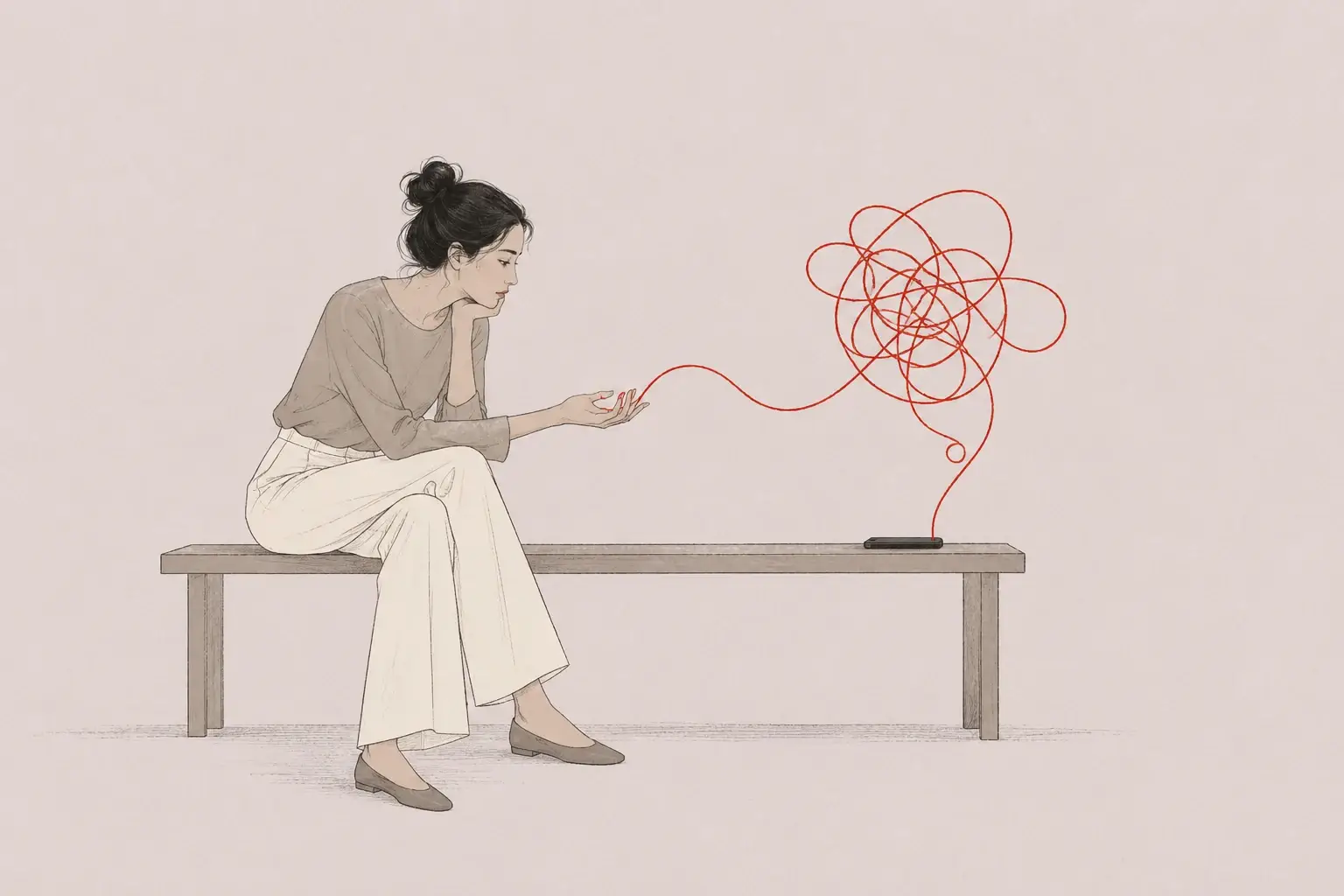
Anxiety in a relationship: when silence feels like rejection
The message is sent. You check once, then again. Before there is an answer, your mind may already be imagining an argument, a breakup or something you did wrong.
Anxiety can affect thoughts, physical feelings and behaviour, as the NHS explains [1]. But a delayed reply alone cannot tell you what your partner feels. Look at the wider context, including what you have actually agreed about communication.
Anxious thoughts are not the same as facts
Try three short lines: What happened? What am I afraid it means? What do I need? Keep the first line limited to what you could observe.
Fact: My partner has not answered my message yet.
Fear: They may be losing interest.
Need: A clearer agreement about when we normally check in.
This is not a way to prove everything is fine. It helps you see where information ends and interpretation begins. For the broader pattern, read why you may overthink your relationship.
Try it here · No score, no sign-up
A pause before the next check
Choose the situation closest to yours. The prompts help organise a next step; they cannot assess your partner or your relationship. Your choice is not submitted or saved.
This is an ordinary delay
- Name the fact without adding a motive: there is no reply yet. You do not know the reason from this alone.
- If it feels comfortable, look around and notice three ordinary things in the room. Let your breathing stay natural.
- Choose one activity to return to. If you need to confirm practical plans, send a clear practical question rather than testing whether you are loved.
An agreement keeps being broken
- Identify the actual agreement and what has happened. A repeated pattern deserves a conversation.
- Prepare a concrete request: can we agree when we will confirm plans and what happens if that changes?
- Notice the response over time. Your needs matter; you do not have to explain every difficulty as anxious thinking.
I keep needing reassurance
- Notice what you hope the next check will settle. Has the same question already been answered?
- If you can, pause and choose a different activity without requiring the doubt to disappear first. This is an optional reflection, not an OCD treatment exercise.
- If checking feels hard to control or disrupts daily life, discuss it with a qualified professional. Specialist assessment may be appropriate.
When relationship reassurance becomes a loop
A caring reply can matter. Notice, though, if you ask the same question repeatedly and each answer settles you only briefly. More reassurance may not give you the certainty you are trying to reach.
Repeated checking and reassurance seeking can also occur in relationship-focused OCD, but anxiety about a reply does not establish that diagnosis. The International OCD Foundation explains the distinction [2]. If unwanted doubts and rituals take up substantial time, seek an assessment from an appropriately qualified professional.
Ask for clearer communication
Choose a time when neither of you is rushing. Describe the pattern, explain its effect and make a realistic request. A partner can care about you without being available at every moment.
When our evening plans are unclear, I notice I keep checking my phone. Could we agree when we will confirm plans, and let each other know if that changes?
The NHS suggests distinguishing practical problems you can act on from worries outside your control. [3] An agreed check-in is a practical step. Re-reading a message until it feels completely certain may leave the original worry unresolved.
Fear of rejection deserves attention
If a delayed reply repeatedly brings shame or fear of abandonment, you can explore that pattern without blaming yourself. Therapy for relationship anxiety and fear of rejection offers space to understand these responses.
Context still matters. Repeatedly broken agreements, dishonesty, threats or controlling behaviour should not be dismissed as your anxiety. If you feel unsafe, seek individual and specialist support rather than using a communication exercise to make the situation work.
Watch and listen · 44 seconds
A pause for anxious relationship thoughts
Spoken guidance with on-screen captions and a transcript. Narration uses an AI voice. Press play to listen.
Read the video transcript
When your partner has not replied, your mind may rush to the worst explanation. Before checking again, separate what happened from what you fear.
The fact is: there is no reply yet. The fear might be: I am being rejected. A delayed message does not prove that fear.
If unclear plans keep causing distress, choose a calm moment to ask for a practical agreement about when you will check in.
Repeatedly broken agreements or controlling behaviour deserve attention. You do not have to dismiss every concern as your anxiety.
If anxious thoughts and checking keep taking over, support is available. Read the guide below, or explore relationship anxiety therapy.
Questions you may be asking
Why do I get anxious when my partner does not reply?
A gap in contact can bring up uncertainty, fear of rejection or past experiences. It can also expose unclear or repeatedly broken communication agreements. The context matters, and a delayed message alone cannot tell you what your partner thinks.
How can I respond to anxious thoughts about my relationship?
Separate the event from your interpretation, then identify any practical request you can make. Notice repeated checking or reassurance seeking. If the pattern is persistent or disruptive, professional support can help you understand what is happening.
Does relationship anxiety mean I have OCD?
No. Relationship worries alone do not establish OCD. Recurrent unwanted doubts together with compulsive checking, reassurance or other rituals may warrant specialist assessment. This article and the reflection exercise are not diagnostic tools.
Sources and further reading
- NHS Every Mind Matters: managing anxiety. Background on anxiety, thoughts, physical feelings and behaviour.
- International OCD Foundation: relationship OCD. Specialist information on obsessive doubts and compulsions, not a diagnosis for readers.
- NHS Every Mind Matters: tackling your worries. Distinguishing practical problems from hypothetical worries.
Sources checked 8 October 2026. Examples and reflection prompts are original. This article offers general information, not an individual assessment or emergency support.
If you cannot keep yourself safe, seek urgent help. In the UK, use the NHS urgent mental health support guide. Elsewhere, use your local emergency or crisis service.