Relationship words, explained
Love bombing: a good beginning, or too much too soon?
By Kita Tabachka, BACP-registered relational therapist
The short answer. Love bombing is a pattern of overwhelming attention, gifts and declarations early in a relationship. It speeds up commitment and makes the other person easier to control. Intensity on its own proves nothing. Watch what happens when you say no or ask to slow down.
Three weeks in, flowers arrive at your office for the second time. He has used the word soulmate. She has looked at flats in your postcode. Your friends are impressed and your sister has gone quiet. You feel chosen, and slightly out of breath.
Both things are true at once. It is lovely, and something in your body is asking for a pause.
Where the phrase comes from
The phrase dates from the 1970s. Members of the Unification Church used it for the flood of affection directed at new recruits. Psychologists later borrowed it for romantic relationships, where the same sequence appears: a rush of warmth first, a request for loyalty second.
What love bombing looks like
Speed. "I love you" in the second week. Talk of moving in by the second month. A holiday booked before you have met each other's friends.
Volume. Forty messages a day. Gifts out of proportion to how long you have known each other. Compliments so large you do not recognise yourself in them.
A future in great detail. The names of your children, the dog, the house by the sea. When the plans never turn into a booking or a date in the diary, people call it future faking.
Less room for everyone else. A sigh when you see your friends. "I only want to be with you" said as romance, and working as a fence.
The test: ask to slow down
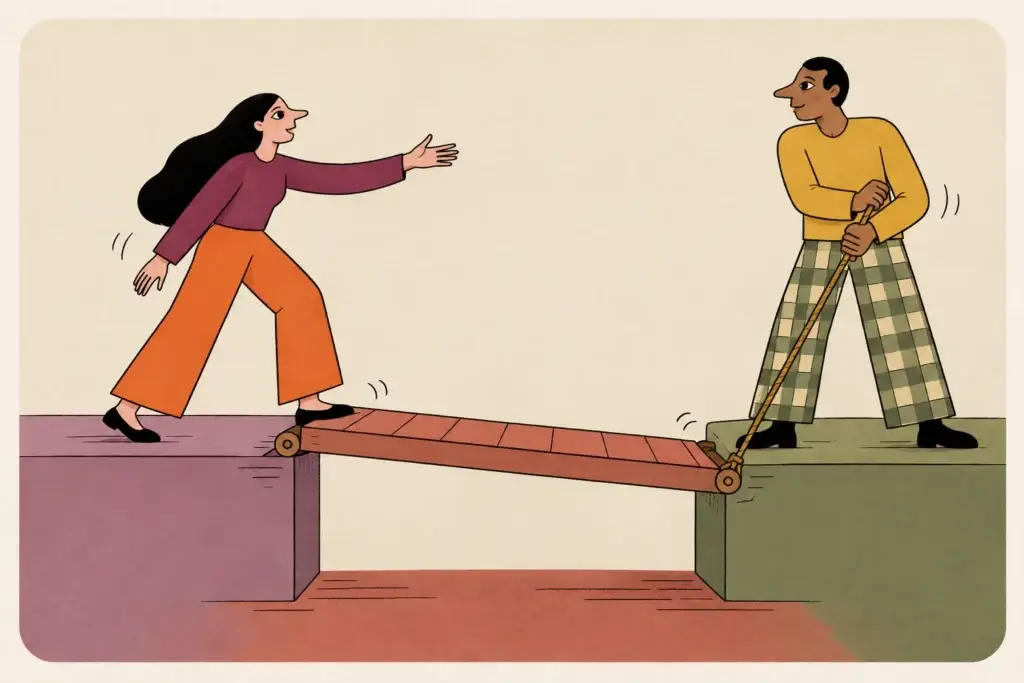
A keen, kind person and a love bomber look alike in week three. They separate the moment you set a pace. Say this: "I like you, and I want to go slower. Let's see each other twice a week this month."
A person who is keen and kind is disappointed and adjusts. A person who is love bombing sulks, argues, raises the stakes with a bigger gesture, or goes cold to punish you. You learn more from one small no than from a month of flowers.
Why it works on kind, sensible people
If you have gone a long time without attention, a flood of it feels like rescue. If you grew up earning affection, being adored for nothing feels like the correction you were owed. Neither makes you foolish. You had an unmet need, and someone offered you a great deal of it at speed.
Not every love bomber is a schemer. Some people flood a new partner because closeness feels urgent and waiting feels unbearable: the anxious, the lonely, the recently left. The effect on you is similar. The risk is different. A frightened person slows down when you ask. A controlling person hears your pace as an insult.
What it turns into
Where control is the aim, the warmth is withdrawn once you are committed. Criticism arrives in its place, with the occasional return of the early sweetness. You spend your energy trying to get back to week three. A bond built on cruelty mixed with affection is hard to leave, and it has its own name: a trauma bond. The dating words guide explains it.
What to do if this is your relationship
- Keep your week. Friends on Thursday, the gym, your Sunday call home. A new partner who is good for you fits around a life. They do not replace it.
- Put big decisions on a ninety-day delay. Moving in, lending money, changing jobs or cities. Nothing good is lost by waiting three months.
- Tell one honest friend the whole timeline. Dates, gifts, what was said and when. Watch their face while you talk.
- Say one small no. Decline one plan this week with no excuse attached. Their reaction is your information.
When this is a safety matter. If the affection has turned into checking your phone, deciding who you see, tracking where you are, or anger when you are out of contact, you are describing coercive control. It is a criminal offence in England and Wales. Couple exercises are the wrong response. In the UK, Refuge runs the National Domestic Abuse Helpline on 0808 2000 247, free, day and night. The Men's Advice Line is 0808 801 0327. Outside the UK, look for the domestic abuse service in your country.
Recognise yourself here? Reading explains the pattern. Changing it takes practice with someone beside you. Start with a free 20-minute conversation.
Book a free consultationWhat working on this with me looks like
We start with a free 20-minute consultation by video. You tell me what is going on, I tell you how I would work with it, and you decide.
Sessions are online, 50 minutes, £70, weekly. We set a review date at the start so the work has a shape. If you would rather write than talk, written counselling costs £50 a week. Read more about individual therapy with me.
Questions people ask about love bombing
How long does love bombing last? Often a few weeks to a few months. It tends to stop once commitment is secured: you have moved in, become exclusive or cut back on friends.
Is love bombing always deliberate? No. Some people do it out of anxiety and a fear of being left. The test is the same in both cases: ask to slow down and watch the response.
How is love bombing different from the honeymoon phase? In a honeymoon phase both people set the pace and either one is free to say "not yet". In love bombing one person sets the pace and a no carries a cost.
Related reading: what is limerence? · 18 dating words explained · attachment styles in relationships
Not sure what you are in?
I work online with individuals and couples in the UK and abroad. Individual sessions last 50 minutes and cost £70. The first conversation is free.
Book a free consultationIndividual therapyMessage me on WhatsAppThis article is education. It does not assess risk and it does not replace therapy or specialist support.