KITA TABACHKA, MBACP · BACP REGISTERED THERAPIST
When the conversation follows you to bed
The room is quiet. Your mind is still in the argument. A page to separate what happened from what you fear it means.
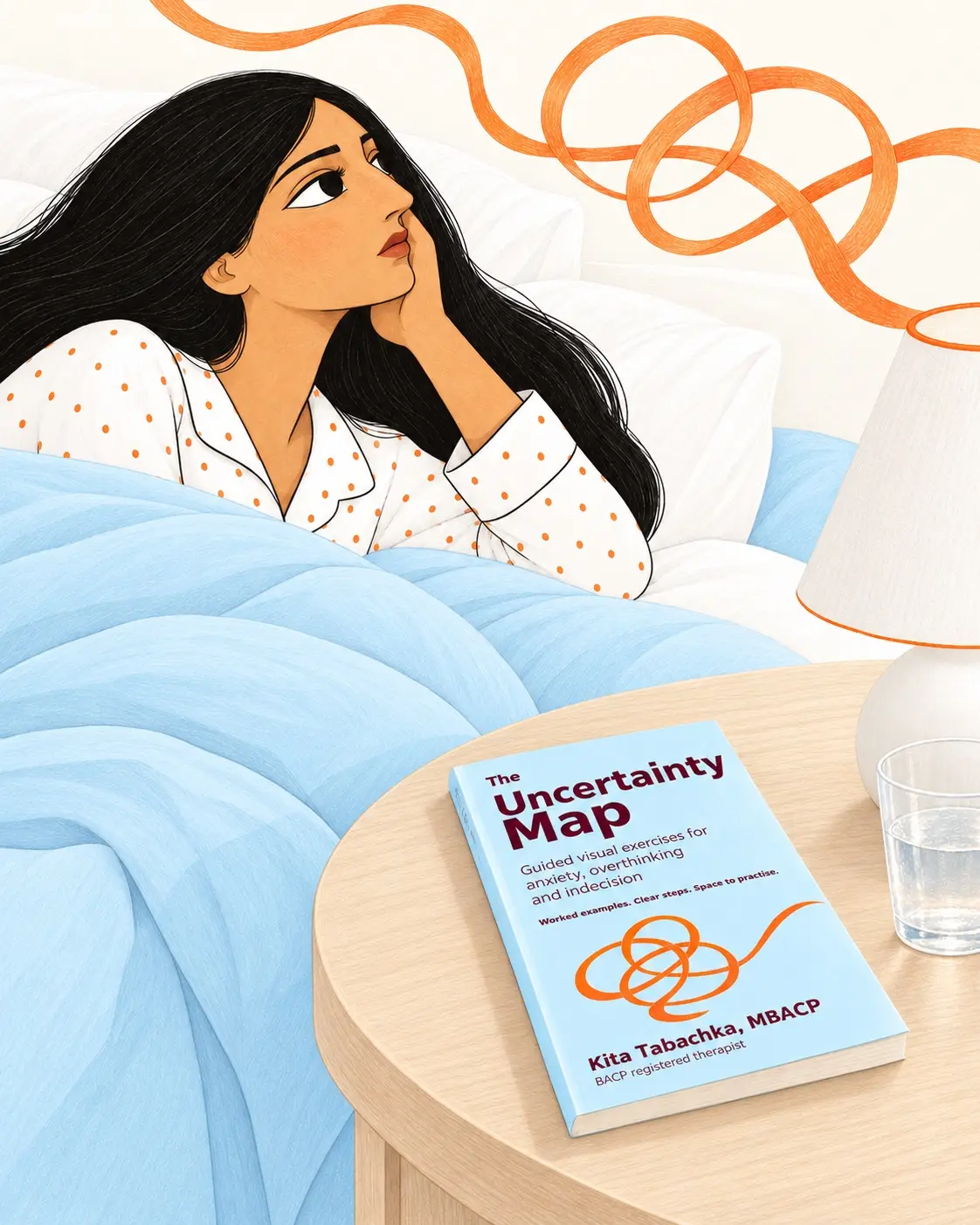
The conversation ended hours ago. You are still reviewing the wording, the pause, the look on their face. Another replay can feel like it might finally make everything clear.
Put the replay into three short lines
Take one moment, rather than the whole relationship, and write: what happened; what I am imagining it means; what I can check or do next.
For example: “They have not replied” is an observation. “They are going to leave” is a prediction. “I can decide when to check my messages again” is a possible action. Separating these does not prove the fear wrong. It makes the different parts easier to see.
Choose a question with an action
Ask yourself whether there is something useful to do with this thought today. You might need information, a boundary, a conversation or a break from checking. Some uncertainty may remain even after a sensible step.
The NHS describes writing worries down and distinguishing practical problems from hypothetical worries as self-help approaches. These are options to try, not a promise that difficult thoughts will disappear.
Start with one map
The Uncertainty Map includes a “Facts and forecasts” exercise alongside 17 other core maps, fictional worked examples and guided writing pages. Its fillable companion gives you a place to type your responses.
If replaying is happening after an affair, Can We Get Past This? adds tools for the relationship questions themselves, including current contact, boundaries and accountability.
See the two-workbook PDF bundle: £19.99 together, or £14.99 each. Digital downloads only.
Further reading: NHS Every Mind Matters: tackling your worries.
Educational reading, not individual therapeutic advice. All workbooks are PDF downloads.